Foundry Sand Mixer
ProductOverview
A foundry sand mixer blends base sand with a binder so the mixture can be packed into a mold that holds its shape long enough to pour metal into it. Sand on its own will not keep a cavity, so a binder must be worked onto every grain in the right proportion. Get the mix right and the mold reproduces the pattern cleanly, vents gas, and breaks out easily after casting. Get it wrong and the mold crumbles, sticks, or gives a rough, gas-holed casting. The mixer is therefore the quality gate at the front of the molding process. Different shops run different sand systems: green sand bonded with clay and water, no-bake sand bonded with a resin and chemical catalyst, or resin-coated sand for shell molding, and the mixer must dose and work each one differently.
The machine builds around a Mixer Frame carrying a Mixing Bowl turned by the Main Drive. Base sand comes in through the Sand Feed, binders are metered by the Binder Dosing system, and the finished batch drops through the Discharge Gate gate. The Control System runs the batch and the Guarding and Dust keeps hands out and dust down.
The mulling action
The classic foundry mixer is a muller, and its job is not to stir but to smear. Two heavy Muller Wheel wheels roll over the sand in the Bowl Pan while Plow blades turn fresh sand under them and Side Scraper scrapers keep sand off the wall and back into the path. The rolling pressure shears the binder film thin and rubs it across each grain so the coating is even, which a simple paddle stirrer cannot do. Because the load is heavy and slow, the muller arms hang from a stout Center Shaft and turn at only 15 to 40 rpm under high torque. The bowl takes constant abrasion from the damp sand, so it carries a replaceable Wear Liner that is swapped as it wears rather than scrapping the whole pan.
Charging and weighing
A repeatable mix starts with a repeatable charge. The Sand Feed meters base sand from the Sand Hopper through a Feed Gate, and a Weigh Load Cell checks the batch weight so the binder ratio is right. On continuous mixers a Belt Feeder doses sand at a steady rate instead of by batch. The base sand itself is chosen for the job: ordinary silica for most work, chromite or olivine where a casting runs hot enough to react with silica or where extra chilling is wanted. Whatever the sand, the mixer must add binder against a known mass of grain, which is why the weigh step is built in rather than left to the operator's eye.
Binder dosing
This is where sand systems diverge. For green sand the Binder Dosing system adds bentonite clay with the dry sand and sprays tempering water through the Water Valve while a Moisture Probe in the bowl closes the loop on moisture, since a percent too wet or too dry changes mold strength. For no-bake sand the Resin Pump meters furan or phenolic resin and the Catalyst Pump meters the acid catalyst that sets it, both checked by a Flow Meter. A Spray Bar lays the liquids over the sand as the mullers work. No-bake mixing is a race against the catalyst, because once resin and catalyst meet the sand begins to harden, so the mix must be brief and the batch must leave the bowl before it sets.
Discharge and timing
No-bake sand has a work life of a few minutes, so the Discharge Gate gate is built to dump a finished batch quickly. The Gate Door in the bowl floor is thrown open by a Gate Cylinder and the sand drops through the Discharge Chute to the molding station before it begins to harden. Batch mullers fill, mix and dump on a cycle; continuous mixers, common on no-bake lines, feed sand and binder in at one end of a screw or trough and discharge a steady stream of ready sand at the other, with mixing happening as the sand travels.
Drive, control and use
The Main Drive pairs a high-torque motor with a gear reducer because churning wet, clay-laden sand draws heavy, steady load. The whole batch sequence of weigh, dose, mix and discharge is run by the PLC and set up on the Operator HMI, where the operator keeps a recipe per sand type with its binder ratios, mix time and moisture target. Because mixing throws up sand dust and, on no-bake systems, resin and catalyst fumes, the bowl carries a Bowl Lid and Dust Pickup that draw the air to a collector, and a Lid Interlock stops the drive if the lid is lifted. Mixers range from small batch mullers in jobbing shops to large continuous units feeding automated molding lines, but all share the same task: deliver sand of a known, repeatable strength to the molder.
Foundry Sand Mixer parts and their functions
8 top-level parts · 93 parts in total · full bill of materials below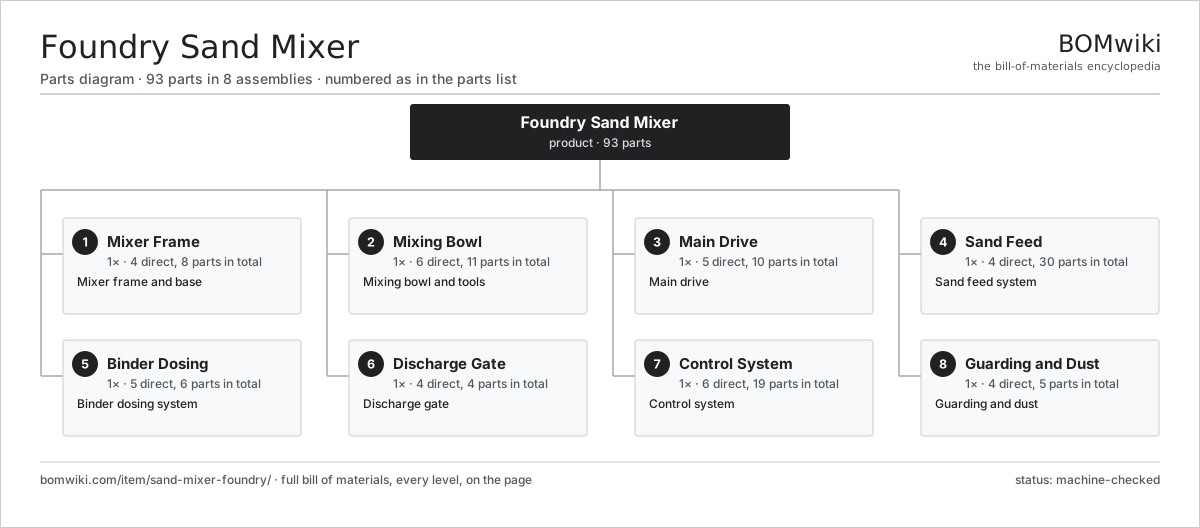
| # | Part | Qty | What it does |
|---|---|---|---|
| 1 | Mixer Frame 4 parts | 1× | Mixer frame and base |
| 2 | Mixing Bowl 6 parts | 1× | Mixing bowl and tools |
| 3 | Main Drive 5 parts | 1× | Main drive |
| 4 | Sand Feed 4 parts | 1× | Sand feed system |
| 5 | Binder Dosing 5 parts | 1× | Binder dosing system |
| 6 | Discharge Gate 4 parts | 1× | Discharge gate |
| 7 | Control System 6 parts | 1× | Control system |
| 8 | Guarding and Dust 4 parts | 1× | Guarding and dust |
3D model
No 3D model yet. Have a CAD file of this? Add a 3D model — STL renders right on this page; STEP, FreeCAD, and OpenSCAD sources are welcome too (openly licensed, like all 3D models on BOMwiki).
Build & assembly graph
expand / collapse · shared sub-assemblies converge · links to related products · est. labourTap an assembly to expand/collapse · tap a part to open it · use “Open page” for any node · drag to pan, scroll to zoom.
Bill of materials for Foundry Sand Mixer
8 top-level lines · 56 rows shown · 93 parts total · indented to 3 levels| # | Item / sub-assembly | Part no. | Qty/assy | Ext. qty | Parts | Type |
|---|---|---|---|---|---|---|
| 1 | Mixer Frame 4 parts | sand-mixer-foundry-frame | 1× | 1 | 8 | assembly |
| 1.1 | Base Weldment | sand-mixer-foundry-base-weldment | 1× | 1 | · | part |
| 1.2 | Support Column | sand-mixer-foundry-column | 1× | 1 | · | part |
| 1.3 | Leveling Foot | sand-mixer-foundry-leveling-foot | 4× | 4 | · | part |
| 1.4 | Fastener Set | fastener-set | 2× | 2 | · | part |
| 2 | Mixing Bowl 6 parts | sand-mixer-foundry-mixing-bowl | 1× | 1 | 11 | assembly |
| 2.1 | Bowl Pan | sand-mixer-foundry-bowl-pan | 1× | 1 | · | part |
| 2.2 | Wear Liner | sand-mixer-foundry-wear-liner | 1× | 1 | · | part |
| 2.3 | Muller Wheel | sand-mixer-foundry-muller-wheel | 2× | 2 | · | part |
| 2.4 | Plow | sand-mixer-foundry-plow | 4× | 4 | · | part |
| 2.5 | Side Scraper | sand-mixer-foundry-scraper | 2× | 2 | · | part |
| 2.6 | Center Shaft | sand-mixer-foundry-center-shaft | 1× | 1 | · | part |
| 3 | Main Drive 5 parts | sand-mixer-foundry-drive | 1× | 1 | 10 | assembly |
| 3.1 | Drive Motor | sand-mixer-foundry-drive-motor | 1× | 1 | · | part |
| 3.2 | Gearbox Housing | gearbox-housing | 1× | 1 | · | part |
| 3.3 | Helical Gear Pair | gear-pair | 2× | 2 | · | part |
| 3.4 | Ball Bearing | ball-bearing | 4× | 4 | · | part |
| 3.5 | Oil Seal | oil-seal | 2× | 2 | · | part |
| 4 | Sand Feed 4 parts | sand-mixer-foundry-sand-feed | 1× | 1 | 30 | assembly |
| 4.1 | Sand Hopper | sand-mixer-foundry-sand-hopper | 1× | 1 | · | part |
| 4.2 | Feed Gate | sand-mixer-foundry-feed-gate | 1× | 1 | · | part |
| 4.3 | Weigh Load Cell | sand-mixer-foundry-weigh-cell | 1× | 1 | · | part |
| 4.4 | Belt Feeder 3 parts | sand-mixer-foundry-belt-feeder | 1× | 1 | 27 | assembly |
| 4.4.1 | Drive Belt | drive-belt | 1× | 1 | · | part |
| 4.4.2 | Servo Motor 4 parts + deeper › | servo-motor | 1× | 1 | 24 | assembly |
| 4.4.3 | Ball Bearing | ball-bearing | 2× | 2 | · | part |
| 5 | Binder Dosing 5 parts | sand-mixer-foundry-binder-dosing | 1× | 1 | 6 | assembly |
| 5.1 | Water Valve | sand-mixer-foundry-water-valve | 1× | 1 | · | part |
| 5.2 | Resin Pump | sand-mixer-foundry-resin-pump | 1× | 1 | · | part |
| 5.3 | Catalyst Pump | sand-mixer-foundry-catalyst-pump | 1× | 1 | · | part |
| 5.4 | Flow Meter | sand-mixer-foundry-flow-meter | 2× | 2 | · | part |
| 5.5 | Spray Bar | sand-mixer-foundry-spray-bar | 1× | 1 | · | part |
| 6 | Discharge Gate 4 parts | sand-mixer-foundry-discharge | 1× | 1 | 4 | assembly |
| 6.1 | Gate Door | sand-mixer-foundry-gate-door | 1× | 1 | · | part |
| 6.2 | Gate Cylinder | sand-mixer-foundry-gate-cylinder | 1× | 1 | · | part |
| 6.3 | Discharge Chute | sand-mixer-foundry-chute | 1× | 1 | · | part |
| 6.4 | O-Ring Set | oring-set | 1× | 1 | · | part |
| 7 | Control System 6 parts | sand-mixer-foundry-control | 1× | 1 | 19 | assembly |
| 7.1 | PLC 4 parts | sand-mixer-foundry-plc | 1× | 1 | 7 | assembly |
| 7.1.1 | Bare PCB | pcb-bare | 1× | 1 | · | part |
| 7.1.2 | Microcontroller | mcu | 1× | 1 | · | part |
| 7.1.3 | Relay | relay | 4× | 4 | · | part |
| 7.1.4 | SMD Passive (R/C/L) | smd-passives | 1× | 1 | · | part |
| 7.2 | Operator HMI 3 parts | sand-mixer-foundry-hmi | 1× | 1 | 3 | assembly |
| 7.2.1 | LCD Panel | lcd-panel | 1× | 1 | · | part |
| 7.2.2 | Microcontroller | mcu | 1× | 1 | · | part |
| 7.2.3 | Bare PCB | pcb-bare | 1× | 1 | · | part |
| 7.3 | Power Supply | power-supply | 1× | 1 | · | part |
| 7.4 | Moisture Probe | sand-mixer-foundry-moisture-probe | 1× | 1 | · | part |
| 7.5 | Wire Bundle | wire-bundle | 1× | 1 | · | part |
| 7.6 | Connector | connector | 6× | 6 | · | part |
| 8 | Guarding and Dust 4 parts | sand-mixer-foundry-guarding | 1× | 1 | 5 | assembly |
| 8.1 | Bowl Lid | sand-mixer-foundry-bowl-lid | 1× | 1 | · | part |
| 8.2 | Dust Pickup | sand-mixer-foundry-dust-pickup | 1× | 1 | · | part |
| 8.3 | Lid Interlock | sand-mixer-foundry-lid-switch | 1× | 1 | · | part |
| 8.4 | Sheet Metal Panel | sheet-panel | 2× | 2 | · | part |
Related products
same domain, ranked by shared parts Industrial Parts Washer
423 parts · shares 24 with this page
Industrial Parts Washer
423 parts · shares 24 with this page
 Rubber Extrusion Line
524 parts · shares 23 with this page
Powder Coating Line
5,418 parts · shares 23 with this page
Electrocoating Line
2,977 parts · shares 23 with this page
Acid Pickling Line
1,163 parts · shares 22 with this page
Rubber Extrusion Line
524 parts · shares 23 with this page
Powder Coating Line
5,418 parts · shares 23 with this page
Electrocoating Line
2,977 parts · shares 23 with this page
Acid Pickling Line
1,163 parts · shares 22 with this page
Sourcing: possible vendors
Prices, MOQ, and lead times are algorithmic estimates, not quotes, and not claims about these companies. Company mappings are curated by keyword; est. price band $5k–$2M. How estimates work| Vendor | HQ | Specialty | MOQ | Lead time |
|---|---|---|---|---|
| atlascopco.com ↗ | Stockholm, SE | Compressors & industrial | 10 units | 12–20 wks |
|
🇦🇹Andritz
andritz.com ↗
|
Graz, AT | Process plants & machinery | 10 units | 12–20 wks |
| buhlergroup.com ↗ | Uzwil, CH | Food & materials processing | 10 units | 12–20 wks |
| gea.com ↗ | Düsseldorf, DE | Process technology | 10 units | 12–20 wks |
| mhi.com ↗ | Tokyo, JP | Heavy machinery | 10 units | 12–20 wks |
930-word article