Sand Shakeout Machine
ProductOverview
A sand shakeout machine separates a finished casting from the spent sand mold that was poured around it. After metal has been poured into a sand mold and cooled enough to handle, the whole mass of casting and crumbling sand is dropped onto a vibrating deck. The shaking breaks the mold apart, sifts the loose sand down through a grid, and walks the heavier casting across the deck to a discharge point. This is the first step of casting cleaning and the point where the mold sand is recovered for reuse. Shakeout is a hot, dusty, noisy job, so the machine is built to take the punishment of red-hot castings landing on it and to contain the cloud of sand and fume that comes off.
The machine sits on a foundation-mounted Base Frame that carries a Grid Deck on Vibration Isolation springs. An Exciter Drive drive shakes the deck, the sifted sand falls into the Sand Collection hopper, the cleaned castings leave by the Casting Discharge, the Dust Extraction captures the dust, and the Control System runs the drive.
How shakeout works
A loaded mold is dropped or pushed onto the Grid Deck. The deck is driven into a steady oscillation by the Exciter Drive, and that vibration does two jobs at once. It fractures the bonded sand mold so the sand crumbles back to loose grains, and it conveys material across the deck because the stroke is angled so each shake nudges everything slightly toward the discharge end. Loose sand falls between the Grid Bar bars into the hopper below, while the casting, too big to pass through, rides across the bars and off the end. The deck is sized so the casting spends enough time on it for the mold to shake clean before it reaches the Discharge Chute. The harder and longer the shake, the cleaner the casting, traded against the wear and noise it costs.
The exciter and how it shakes
The shake comes from rotating unbalance, not from a crank. Two Vibration Motor motors, or an Exciter Shaft carrying Unbalance Weight eccentric weights, spin in time so their centrifugal forces add along one axis and cancel across it. That produces a clean linear shake of a few millimetres at several hundred to over a thousand cycles a minute. The Unbalance Weight weights are adjustable, so a foundry can tune stroke for the size and fragility of its castings. The exciter runs on heavy Ball Bearing bearings and Oil Seal seals because it lives in a constant rain of hot abrasive dust. Tuning the deck near its natural frequency lets a modest drive throw a heavy load, which is why the deck must be ramped carefully through resonance on start-up and shutdown.
Isolation and the frame
The deck has to shake violently while the building does not, so the Vibration Isolation system stands between them. Eight or more steel Coil Spring springs carry the deck, soft enough that almost none of the shaking force reaches the Base Weldment base, which is bolted to a heavy foundation block. Travel Snubber snubbers limit deck travel if a heavy mold lands off-centre, and Isolator Pad pads under the base block any residual vibration into the floor. Getting this right matters because an under-isolated shakeout cracks foundations and shakes nearby machines out of alignment.
Sand recovery and tramp removal
Everything that falls through the grid is the foundry's sand to reclaim, so the Sand Collection system keeps it clean. The Collection Hopper funnels sifted sand onto the Sand Conveyor, a Lump Breaker crushes baked lumps, and a Tramp Magnet pulls out stray steel, flash and broken chaplets before the sand reaches the reclaim plant. Removing this tramp metal protects the downstream coolers, screens and mixers. The recovered sand is then cooled, screened and re-bonded, so the shakeout is the head of the sand reclaim loop as much as the tail of the casting line.
Dust, control and variants
Hot castings landing in sand throw up a dense cloud of silica dust and burnt-binder fume, which is both a health hazard and a fire risk, so the deck runs inside an Enclosure with a Capture Hood feeding a Extraction Fan that pulls the air to the foundry baghouse. The Control System system uses a Variable Frequency Drive drive to ramp the exciters through resonance smoothly and Vibration Sensor sensors to watch deck amplitude and bearing health. Machines range from simple grid decks where the operator pulls castings off by hand, to brute-force vibrating tables, to rotary tumbling drums that shake and cool castings as they pass through. All do the same job: get the casting out of the sand and the sand back into the system.
Sand Shakeout Machine parts and their functions
8 top-level parts · 129 parts in total · full bill of materials below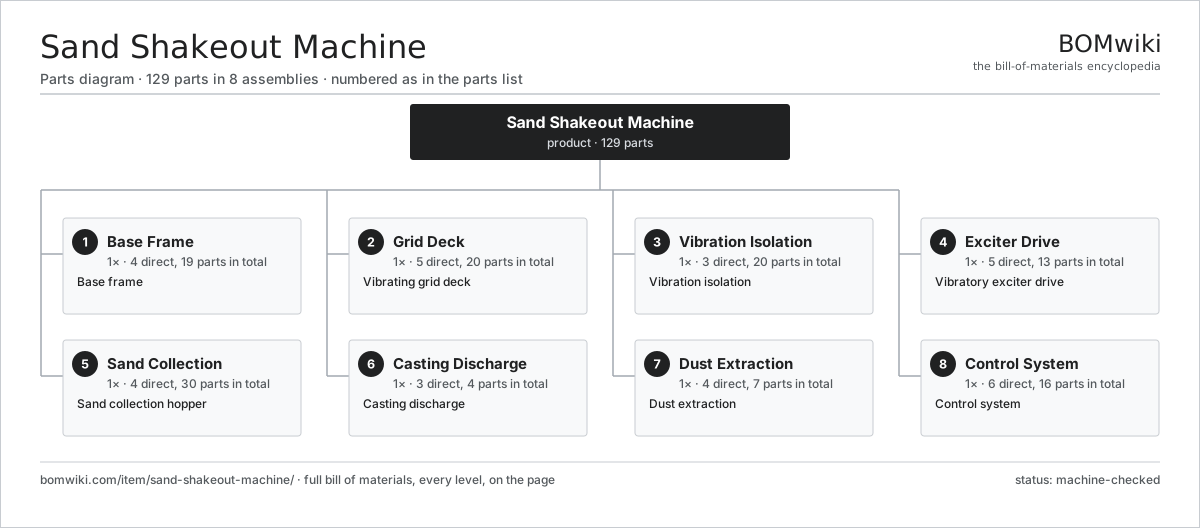
| # | Part | Qty | What it does |
|---|---|---|---|
| 1 | Base Frame 4 parts | 1× | Base frame |
| 2 | Grid Deck 5 parts | 1× | Vibrating grid deck |
| 3 | Vibration Isolation 3 parts | 1× | Vibration isolation |
| 4 | Exciter Drive 5 parts | 1× | Vibratory exciter drive |
| 5 | Sand Collection 4 parts | 1× | Sand collection hopper |
| 6 | Casting Discharge 3 parts | 1× | Casting discharge |
| 7 | Dust Extraction 4 parts | 1× | Dust extraction |
| 8 | Control System 6 parts | 1× | Control system |
3D model
No 3D model yet. Have a CAD file of this? Add a 3D model — STL renders right on this page; STEP, FreeCAD, and OpenSCAD sources are welcome too (openly licensed, like all 3D models on BOMwiki).
Build & assembly graph
expand / collapse · shared sub-assemblies converge · links to related products · est. labourTap an assembly to expand/collapse · tap a part to open it · use “Open page” for any node · drag to pan, scroll to zoom.
Bill of materials for Sand Shakeout Machine
8 top-level lines · 49 rows shown · 129 parts total · indented to 3 levels| # | Item / sub-assembly | Part no. | Qty/assy | Ext. qty | Parts | Type |
|---|---|---|---|---|---|---|
| 1 | Base Frame 4 parts | sand-shakeout-machine-frame | 1× | 1 | 19 | assembly |
| 1.1 | Base Weldment | sand-shakeout-machine-base-weldment | 1× | 1 | · | part |
| 1.2 | Spring Mount | sand-shakeout-machine-spring-mount | 8× | 8 | · | part |
| 1.3 | Anchor Bolt | sand-shakeout-machine-anchor-bolt | 8× | 8 | · | part |
| 1.4 | Fastener Set | fastener-set | 2× | 2 | · | part |
| 2 | Grid Deck 5 parts | sand-shakeout-machine-grid-deck | 1× | 1 | 20 | assembly |
| 2.1 | Deck Frame | sand-shakeout-machine-deck-frame | 1× | 1 | · | part |
| 2.2 | Grid Bar | sand-shakeout-machine-grid-bar | 12× | 12 | · | part |
| 2.3 | Wear Plate | sand-shakeout-machine-wear-plate | 4× | 4 | · | part |
| 2.4 | Deck Liner | sand-shakeout-machine-deck-liner | 1× | 1 | · | part |
| 2.5 | Side Wall | sand-shakeout-machine-side-wall | 2× | 2 | · | part |
| 3 | Vibration Isolation 3 parts | sand-shakeout-machine-isolation | 1× | 1 | 20 | assembly |
| 3.1 | Coil Spring | coil-spring | 8× | 8 | · | part |
| 3.2 | Travel Snubber | sand-shakeout-machine-snubber | 4× | 4 | · | part |
| 3.3 | Isolator Pad | sand-shakeout-machine-isolator-pad | 8× | 8 | · | part |
| 4 | Exciter Drive 5 parts | sand-shakeout-machine-exciter | 1× | 1 | 13 | assembly |
| 4.1 | Vibration Motor | sand-shakeout-machine-vibration-motor | 2× | 2 | · | part |
| 4.2 | Unbalance Weight | sand-shakeout-machine-unbalance-weight | 4× | 4 | · | part |
| 4.3 | Exciter Shaft | sand-shakeout-machine-exciter-shaft | 1× | 1 | · | part |
| 4.4 | Ball Bearing | ball-bearing | 4× | 4 | · | part |
| 4.5 | Oil Seal | oil-seal | 2× | 2 | · | part |
| 5 | Sand Collection 4 parts | sand-shakeout-machine-sand-collection | 1× | 1 | 30 | assembly |
| 5.1 | Collection Hopper | sand-shakeout-machine-collect-hopper | 1× | 1 | · | part |
| 5.2 | Sand Conveyor 3 parts | sand-shakeout-machine-sand-conveyor | 1× | 1 | 27 | assembly |
| 5.2.1 | Drive Belt | drive-belt | 1× | 1 | · | part |
| 5.2.2 | Servo Motor 4 parts + deeper › | servo-motor | 1× | 1 | 24 | assembly |
| 5.2.3 | Ball Bearing | ball-bearing | 2× | 2 | · | part |
| 5.3 | Lump Breaker | sand-shakeout-machine-lump-breaker | 1× | 1 | · | part |
| 5.4 | Tramp Magnet | sand-shakeout-machine-magnet | 1× | 1 | · | part |
| 6 | Casting Discharge 3 parts | sand-shakeout-machine-casting-discharge | 1× | 1 | 4 | assembly |
| 6.1 | Discharge Chute | sand-shakeout-machine-discharge-chute | 1× | 1 | · | part |
| 6.2 | Apron Plate | sand-shakeout-machine-apron-plate | 1× | 1 | · | part |
| 6.3 | Impact Bar | sand-shakeout-machine-impact-bar | 2× | 2 | · | part |
| 7 | Dust Extraction 4 parts | sand-shakeout-machine-dust-system | 1× | 1 | 7 | assembly |
| 7.1 | Enclosure | sand-shakeout-machine-enclosure | 1× | 1 | · | part |
| 7.2 | Capture Hood | sand-shakeout-machine-dust-hood | 1× | 1 | · | part |
| 7.3 | Extraction Fan | sand-shakeout-machine-dust-fan | 1× | 1 | · | part |
| 7.4 | Sheet Metal Panel | sheet-panel | 4× | 4 | · | part |
| 8 | Control System 6 parts | sand-shakeout-machine-control | 1× | 1 | 16 | assembly |
| 8.1 | Variable Frequency Drive | sand-shakeout-machine-vfd | 1× | 1 | · | part |
| 8.2 | Vibration Sensor | sand-shakeout-machine-vib-sensor | 2× | 2 | · | part |
| 8.3 | Control Panel 4 parts | sand-shakeout-machine-control-panel | 1× | 1 | 7 | assembly |
| 8.3.1 | Bare PCB | pcb-bare | 1× | 1 | · | part |
| 8.3.2 | Microcontroller | mcu | 1× | 1 | · | part |
| 8.3.3 | Relay | relay | 4× | 4 | · | part |
| 8.3.4 | LCD Panel | lcd-panel | 1× | 1 | · | part |
| 8.4 | Power Supply | power-supply | 1× | 1 | · | part |
| 8.5 | Wire Bundle | wire-bundle | 1× | 1 | · | part |
| 8.6 | Connector | connector | 4× | 4 | · | part |
Related products
same domain, ranked by shared parts Rubber Extrusion Line
524 parts · shares 20 with this page
Rubber Extrusion Line
524 parts · shares 20 with this page
 Tensile Testing Machine
608 parts · shares 20 with this page
Spin Welding Machine
91 parts · shares 19 with this page
Hammer Mill
790 parts · shares 19 with this page
Tensile Testing Machine
608 parts · shares 20 with this page
Spin Welding Machine
91 parts · shares 19 with this page
Hammer Mill
790 parts · shares 19 with this page
Sourcing: possible vendors
Prices, MOQ, and lead times are algorithmic estimates, not quotes, and not claims about these companies. Company mappings are curated by keyword; est. price band $5k–$2M. How estimates work| Vendor | HQ | Specialty | MOQ | Lead time |
|---|---|---|---|---|
| atlascopco.com ↗ | Stockholm, SE | Compressors & industrial | 10 units | 12–20 wks |
|
🇦🇹Andritz
andritz.com ↗
|
Graz, AT | Process plants & machinery | 10 units | 12–20 wks |
| buhlergroup.com ↗ | Uzwil, CH | Food & materials processing | 10 units | 12–20 wks |
| gea.com ↗ | Düsseldorf, DE | Process technology | 10 units | 12–20 wks |
| mhi.com ↗ | Tokyo, JP | Heavy machinery | 10 units | 12–20 wks |
877-word article