Hot Plate Plastic Welder
ProductOverview
A hot plate welding machine joins two plastic parts by melting their mating faces against a heated metal plate, withdrawing the plate, and pressing the molten faces together so they fuse as they cool. It is the method of choice for large or complex joints that ultrasonic or vibration welding cannot reach, such as automotive fuel tanks, coolant reservoirs, battery cases, ductwork, and large appliance parts. The weld is strong and often hermetic because the whole joint line is melted at once and forged together, but each cycle is slower than ultrasonic because the parts must heat by contact and then cool.
The machine works in four steps: match the parts to the plate, heat them against it, change over by swinging the plate out, and forge the molten faces together. The Machine Frame keeps the platens parallel, the Upper Platen and Tooling and Lower Platen and Tooling carry the two parts, the Heated Platen Assembly melts them, the Heated Plate Shuttle moves that plate in and out, the Platen Drive System supplies the motion and force, and the Control System system sequences it all.
The four-step cycle
The cycle is the same on every machine. First the parts are loaded into the fixtures and the Platen Drive System brings the Upper Platen and Tooling down toward the Heated Platen Assembly that has shuttled into place between the parts. In the heat step both joint faces press lightly against the plate and melt, with the melt depth set by Weld Stop Block limits so it is repeatable. In the change-over step the platen retracts and the Heated Plate Shuttle whips the hot plate out of the way as fast as possible, because the molten faces start to skin over and cool the moment they leave the plate. Finally, in the forge step the platen drives the two molten faces together at a set force and holds them until the joint solidifies into a weld. Change-over speed is critical: a slow change-over lets the melt cool and gives a weak joint, so the shuttle and drive are built to move quickly.
The heated plate
The Heated Platen Assembly is the working tool. A Plate Body of aluminium spreads heat from Heating Element cartridges evenly across the faces, and Plate Thermocouple probes hold the temperature within a few degrees through a PID loop. The melt faces are often shaped as a Profiled Melt Face that matches the part contour so the whole joint line melts evenly rather than just the high spots. For most materials the plate carries a Non-Stick Coating so the melt releases cleanly; for polypropylene and other plastics that string on a coated plate, a bare plate run hotter and held farther from the part, a non-contact heat method, is used instead. Plate temperature and heat time together set how deep the melt runs, and both are tuned to the resin.
Drive, force, and weld depth
The Platen Drive System does two different jobs in one stroke. During heating it holds the parts against the plate at a light melt force, and during forging it pushes the molten faces together at a higher weld force. Servo-driven machines use a Servo Motor and Ball Screw with a Position Encoder and Force Sensor so the melt depth, change-over speed, and weld depth are all programmed and measured; pneumatic machines use a Drive Cylinder with mechanical stops. Weld depth, how far the parts collapse together during forging, is the key quality variable, controlled by Weld Stop Block hard stops or by the encoder. Too little collapse leaves a weak joint, too much squeezes out all the melt and thins the weld.
Fixturing and control
Because the parts are large and must meet exactly, the fixtures matter. The Upper Fixture holds the upper part, often with a Upper Vacuum Holder holder so it does not drop during the change-over, while the Lower Fixture cradles the lower part on Locating Pin features and Part Clamp hardware. The Control System system, built on a PLC with separate Temperature Controller loops for the plate, sequences the heat time, the change-over, and the forge by time and depth, and stores recipes on the Operator Panel. Each variable is logged so welds stay consistent across shifts.
Use and limits
Hot plate welders join large, irregular, and pressure-tight plastic parts: automotive fuel and coolant tanks, washer and dryer tubs, battery and electronics housings, pipe and duct fittings, and pallets. Their strengths are strong full-length welds, the ability to handle big or complex joint geometries that ultrasonic cannot, and hermetic seals suited to fluids and gases. The limits are the longer cycle from contact heating and cooling, the floor space for the plate shuttle and large fixtures, and care needed with materials like polypropylene that stick to a coated plate. Where a small designed-in joint suits an Ultrasonic Welding Machine, that is faster; where the joint is large, contoured, or must hold pressure, hot plate welding is the method that does the job.
Hot Plate Plastic Welder parts and their functions
7 top-level parts · 87 parts in total · full bill of materials below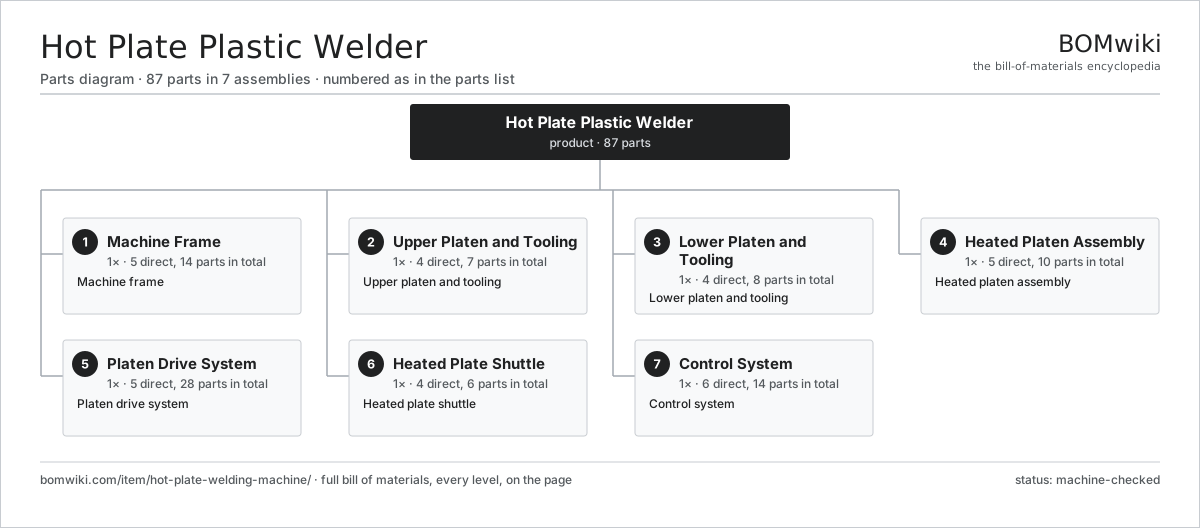
| # | Part | Qty | What it does |
|---|---|---|---|
| 1 | Machine Frame 5 parts | 1× | Machine frame |
| 2 | Upper Platen and Tooling 4 parts | 1× | Upper platen and tooling |
| 3 | Lower Platen and Tooling 4 parts | 1× | Lower platen and tooling |
| 4 | Heated Platen Assembly 5 parts | 1× | Heated platen assembly |
| 5 | Platen Drive System 5 parts | 1× | Platen drive system |
| 6 | Heated Plate Shuttle 4 parts | 1× | Heated plate shuttle |
| 7 | Control System 6 parts | 1× | Control system |
3D model
No 3D model yet. Have a CAD file of this? Add a 3D model — STL renders right on this page; STEP, FreeCAD, and OpenSCAD sources are welcome too (openly licensed, like all 3D models on BOMwiki).
Build & assembly graph
expand / collapse · shared sub-assemblies converge · links to related products · est. labourTap an assembly to expand/collapse · tap a part to open it · use “Open page” for any node · drag to pan, scroll to zoom.
Bill of materials for Hot Plate Plastic Welder
7 top-level lines · 44 rows shown · 87 parts total · indented to 3 levels| # | Item / sub-assembly | Part no. | Qty/assy | Ext. qty | Parts | Type |
|---|---|---|---|---|---|---|
| 1 | Machine Frame 5 parts | hot-plate-welding-machine-frame | 1× | 1 | 14 | assembly |
| 1.1 | Base | hot-plate-welding-machine-base | 1× | 1 | · | part |
| 1.2 | Guide Column | hot-plate-welding-machine-guide-column | 4× | 4 | · | part |
| 1.3 | Cross Head | hot-plate-welding-machine-cross-head | 1× | 1 | · | part |
| 1.4 | Linear Guide Rail | linear-guide | 4× | 4 | · | part |
| 1.5 | Fastener Set | fastener-set | 4× | 4 | · | part |
| 2 | Upper Platen and Tooling 4 parts | hot-plate-welding-machine-upper-platen | 1× | 1 | 7 | assembly |
| 2.1 | Upper Platen Plate | hot-plate-welding-machine-upper-platen-plate | 1× | 1 | · | part |
| 2.2 | Upper Fixture | hot-plate-welding-machine-upper-fixture | 1× | 1 | · | part |
| 2.3 | Upper Vacuum Holder | hot-plate-welding-machine-upper-vacuum | 1× | 1 | · | part |
| 2.4 | Weld Stop Block | hot-plate-welding-machine-stop-block | 4× | 4 | · | part |
| 3 | Lower Platen and Tooling 4 parts | hot-plate-welding-machine-lower-platen | 1× | 1 | 8 | assembly |
| 3.1 | Lower Platen Plate | hot-plate-welding-machine-lower-platen-plate | 1× | 1 | · | part |
| 3.2 | Lower Fixture | hot-plate-welding-machine-lower-fixture | 1× | 1 | · | part |
| 3.3 | Locating Pin | hot-plate-welding-machine-locating-pin | 4× | 4 | · | part |
| 3.4 | Part Clamp | hot-plate-welding-machine-lower-clamp | 2× | 2 | · | part |
| 4 | Heated Platen Assembly 5 parts | hot-plate-welding-machine-heated-plate | 1× | 1 | 10 | assembly |
| 4.1 | Plate Body | hot-plate-welding-machine-plate-body | 1× | 1 | · | part |
| 4.2 | Heating Element | heating-element | 4× | 4 | · | part |
| 4.3 | Non-Stick Coating | hot-plate-welding-machine-ptfe-coating | 1× | 1 | · | part |
| 4.4 | Plate Thermocouple | hot-plate-welding-machine-plate-thermocouple | 2× | 2 | · | part |
| 4.5 | Profiled Melt Face | hot-plate-welding-machine-melt-profile | 2× | 2 | · | part |
| 5 | Platen Drive System 5 parts | hot-plate-welding-machine-platen-drive | 1× | 1 | 28 | assembly |
| 5.1 | Drive Cylinder | hot-plate-welding-machine-drive-cylinder | 1× | 1 | · | part |
| 5.2 | Servo Motor 4 parts | servo-motor | 1× | 1 | 24 | assembly |
| 5.2.1 | Stator Assembly 3 parts + deeper › | stator-assembly | 1× | 1 | 3 | assembly |
| 5.2.2 | Rotor Assembly 4 parts + deeper › | rotor-assembly | 1× | 1 | 19 | assembly |
| 5.2.3 | Encoder | encoder | 1× | 1 | · | part |
| 5.2.4 | Motor Housing | motor-housing | 1× | 1 | · | part |
| 5.3 | Ball Screw | ball-screw | 1× | 1 | · | part |
| 5.4 | Position Encoder | hot-plate-welding-machine-position-encoder | 1× | 1 | · | part |
| 5.5 | Force Sensor | hot-plate-welding-machine-force-sensor | 1× | 1 | · | part |
| 6 | Heated Plate Shuttle 4 parts | hot-plate-welding-machine-plate-shuttle | 1× | 1 | 6 | assembly |
| 6.1 | Shuttle Slide | hot-plate-welding-machine-shuttle-slide | 1× | 1 | · | part |
| 6.2 | Shuttle Cylinder | hot-plate-welding-machine-shuttle-cylinder | 1× | 1 | · | part |
| 6.3 | Linear Guide Rail | linear-guide | 2× | 2 | · | part |
| 6.4 | Shuttle Stop | hot-plate-welding-machine-shuttle-stop | 2× | 2 | · | part |
| 7 | Control System 6 parts | hot-plate-welding-machine-control | 1× | 1 | 14 | assembly |
| 7.1 | PLC | hot-plate-welding-machine-plc | 1× | 1 | · | part |
| 7.2 | Temperature Controller | hot-plate-welding-machine-temp-controller | 2× | 2 | · | part |
| 7.3 | Operator Panel | hot-plate-welding-machine-hmi | 1× | 1 | · | part |
| 7.4 | Power Supply | power-supply | 1× | 1 | · | part |
| 7.5 | Relay | relay | 8× | 8 | · | part |
| 7.6 | Wire Bundle | wire-bundle | 1× | 1 | · | part |
Related products
same domain, ranked by shared parts All-Electric Injection Molding Machine
851 parts · shares 17 with this page
Automated Paint Spray Line
2,003 parts · shares 17 with this page
All-Electric Injection Molding Machine
851 parts · shares 17 with this page
Automated Paint Spray Line
2,003 parts · shares 17 with this page
 Continuous Galvanizing Line
1,296 parts · shares 17 with this page
Continuous Galvanizing Line
1,296 parts · shares 17 with this page
 Industrial 3D Printer
218 parts · shares 17 with this page
Industrial 3D Printer
218 parts · shares 17 with this page
 Industrial Ultrasonic Cleaner
787 parts · shares 17 with this page
Micro Injection Molding Machine
704 parts · shares 17 with this page
Industrial Ultrasonic Cleaner
787 parts · shares 17 with this page
Micro Injection Molding Machine
704 parts · shares 17 with this page
Sourcing: possible vendors
Prices, MOQ, and lead times are algorithmic estimates, not quotes, and not claims about these companies. Company mappings are curated by keyword; est. price band $5k–$2M. How estimates work| Vendor | HQ | Specialty | MOQ | Lead time |
|---|---|---|---|---|
| atlascopco.com ↗ | Stockholm, SE | Compressors & industrial | 10 units | 12–20 wks |
|
🇦🇹Andritz
andritz.com ↗
|
Graz, AT | Process plants & machinery | 10 units | 12–20 wks |
| buhlergroup.com ↗ | Uzwil, CH | Food & materials processing | 10 units | 12–20 wks |
| gea.com ↗ | Düsseldorf, DE | Process technology | 10 units | 12–20 wks |
| mhi.com ↗ | Tokyo, JP | Heavy machinery | 10 units | 12–20 wks |
948-word article