Tensile Testing Machine
ProductOverview
A tensile testing machine, often called a universal testing machine, pulls a specimen apart along one axis while it records the force and how far the specimen stretches. From that force against extension the machine derives the properties engineers care about: yield strength, ultimate tensile strength, elongation at break, and elastic modulus. The same frame can usually push as well as pull, so it serves compression, bend, and shear tests by swapping fixtures, which is why the word universal is attached to it.
The machine is built around a stiff Load Frame that reacts the test force, a Ballscrew Drive that moves the crosshead at a controlled rate, a Load Cell in series with the specimen to measure force, an Extensometer to measure strain precisely, the Grips and Fixtures that hold the specimen, the Controller Electronics that closes the control loop, an Operator Panel for the operator, and a Safety Guard that contains fragments when a brittle specimen snaps.
Load frame and stiffness
The Load Frame decides how accurate the machine can be, because any flex in the frame shows up as false extension. A heavy Frame Base anchors two Guide Column columns that run up to a Fixed Upper Crosshead fixed beam, closing a rigid loop. The Moving Crosshead travels between the columns on Linear Guide Rail rails, carrying the upper grip. Its Crosshead Beam is a box section that stays flat under load so the specimen pulls straight, and Anti-Rotation Bushing bushings keep it square to the load axis. A benchtop frame of this kind might reach 50 kN, while floor-standing twin-column frames run to 300 kN and beyond. The Tee-Slot Work Table on the base takes compression platens and bend fixtures for tests other than tension.
Drive and crosshead motion
Crosshead movement comes from the Ballscrew Drive. A Servo Motor turns a Belt Reducer belt stage, whose Drive Belt and Timing Pulley pulleys split torque to two Ball Screw ballscrews, one beside each column. A Synchronizing Shaft ties the screws together so the crosshead cannot rack, and each screw turns in Ballscrew Support Bearing support bearings that take the test thrust. A Position Encoder reports screw rotation, which the controller turns into crosshead position. Speed can range from 0.001 mm/min for slow modulus measurement up to 1000 mm/min for quick return, and the servo holds that rate steadily as the specimen resists.
Force and strain measurement
Force is read by the Load Cell, which sits in the load string so all of the test force passes through it. Its Load Cell Body flexes by a known amount, and bonded Strain Gauge gauges in a full bridge turn that flex into a millivolt signal that a Bridge Amplifier amplifies. A good cell holds Class 0.5 accuracy, meaning the reading is within half a percent across most of its range, and cells are interchangeable so a small one can be fitted for thin wire and a large one for steel bar.
Crosshead travel is too coarse for elastic modulus because it includes frame and grip take-up, so strain is measured directly by the Extensometer. Two Knife-Edge Arm knife edges clip onto the specimen at the gauge marks, held by Coil Spring springs, and as the gauge length grows the arms bend a Flexure Beam flexure carrying its own strain gauges. Resolution down to about 1 micron over a 50 mm gauge length is normal, which is what lets the machine resolve the straight elastic part of the curve.
Grips and the load string
The Grips and Fixtures hold the specimen without slipping or bending it. Wedge Grip Body wedge grips are self-tightening: the harder the machine pulls, the harder the wedges clamp the jaws, so a round bar or flat coupon cannot pull free. Replaceable Serrated Jaw Insert inserts match the specimen, with serrations for hard metal and smooth or coated faces for soft or polished work. Grip Adapter adapters set the throat and Load-String Coupling couplings tie the grips to the load cell and crosshead, often with a spherical seat that removes off-axis bending so the specimen feels pure tension.
Control, operator panel, and safety
The Controller Electronics runs everything. Its Control Board samples force and strain through Precision ADC converters at up to 2000 Hz, computes the control command, and feeds the Servo Amplifier amplifier that drives the motor. The machine can run in position control for a fixed strain rate, in load control for a held force, or in strain control driven by the extensometer, switching between them mid-test for standards that demand it. The IO and Signal Board handles limit switches and the safety loop.
The operator works at the Operator Panel, using its LCD Panel touchscreen to set up the test and a Jog Control to position the crosshead while fitting specimens. A Safety Guard surrounds the test space with Polycarbonate Panel polycarbonate panels, and a Door Interlock Switch stops the test if the door opens. A Emergency Stop on the panel cuts the servo at once, which matters because a brittle steel or composite specimen releases stored energy sharply when it breaks.
Use and variants
Tensile machines are the workhorse of materials labs, used for batch acceptance of metal stock, qualification of welds, polymer and composite development, and checking that incoming material meets the strength on its certificate. Smaller electromechanical frames cover most metals, plastics, textiles, and films. Servo-hydraulic versions replace the ballscrew drive with a hydraulic actuator for very high forces and for fatigue testing, where the load cycles fast for millions of cycles. The electromechanical type described here is preferred where quiet, clean, precise low-rate testing matters, since the ballscrew gives fine control and needs no hydraulic power pack.
Tensile Testing Machine parts and their functions
8 top-level parts · 608 parts in total · full bill of materials below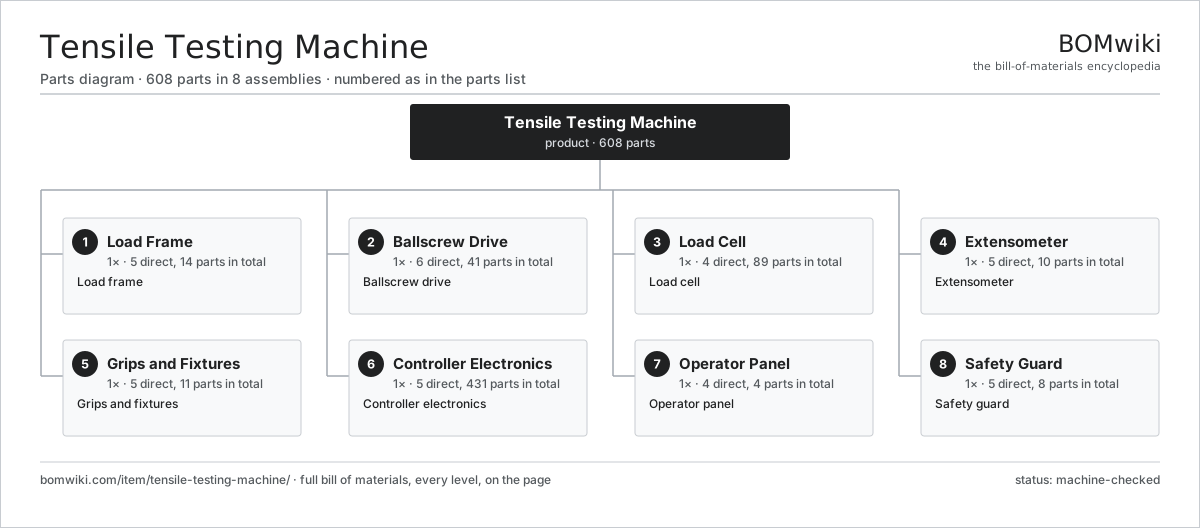
| # | Part | Qty | What it does |
|---|---|---|---|
| 1 | Load Frame 5 parts | 1× | Load frame |
| 2 | Ballscrew Drive 6 parts | 1× | Ballscrew drive |
| 3 | Load Cell 4 parts | 1× | Load cell |
| 4 | Extensometer 5 parts | 1× | Extensometer |
| 5 | Grips and Fixtures 5 parts | 1× | Grips and fixtures |
| 6 | Controller Electronics 5 parts | 1× | Controller electronics |
| 7 | Operator Panel 4 parts | 1× | Operator panel |
| 8 | Safety Guard 5 parts | 1× | Safety guard |
3D model
No 3D model yet. Have a CAD file of this? Add a 3D model — STL renders right on this page; STEP, FreeCAD, and OpenSCAD sources are welcome too (openly licensed, like all 3D models on BOMwiki).
Build & assembly graph
expand / collapse · shared sub-assemblies converge · links to related products · est. labourTap an assembly to expand/collapse · tap a part to open it · use “Open page” for any node · drag to pan, scroll to zoom.
Bill of materials for Tensile Testing Machine
8 top-level lines · 75 rows shown · 608 parts total · indented to 3 levels| # | Item / sub-assembly | Part no. | Qty/assy | Ext. qty | Parts | Type |
|---|---|---|---|---|---|---|
| 1 | Load Frame 5 parts | tensile-testing-machine-load-frame | 1× | 1 | 14 | assembly |
| 1.1 | Frame Base | tensile-testing-machine-base | 1× | 1 | · | part |
| 1.2 | Guide Column | tensile-testing-machine-column | 2× | 2 | · | part |
| 1.3 | Moving Crosshead 4 parts | tensile-testing-machine-crosshead-moving | 1× | 1 | 9 | assembly |
| 1.3.1 | Crosshead Beam | tensile-testing-machine-crosshead-beam | 1× | 1 | · | part |
| 1.3.2 | Linear Guide Rail | linear-guide | 2× | 2 | · | part |
| 1.3.3 | Ballscrew Nut Block | tensile-testing-machine-nut-block | 2× | 2 | · | part |
| 1.3.4 | Anti-Rotation Bushing | tensile-testing-machine-bushing | 4× | 4 | · | part |
| 1.4 | Fixed Upper Crosshead | tensile-testing-machine-crosshead-fixed | 1× | 1 | · | part |
| 1.5 | Tee-Slot Work Table | tensile-testing-machine-table-tee-slot | 1× | 1 | · | part |
| 2 | Ballscrew Drive 6 parts | tensile-testing-machine-drive | 1× | 1 | 41 | assembly |
| 2.1 | Servo Motor 4 parts | servo-motor | 1× | 1 | 24 | assembly |
| 2.1.1 | Stator Assembly 3 parts + deeper › | stator-assembly | 1× | 1 | 3 | assembly |
| 2.1.2 | Rotor Assembly 4 parts + deeper › | rotor-assembly | 1× | 1 | 19 | assembly |
| 2.1.3 | Encoder | encoder | 1× | 1 | · | part |
| 2.1.4 | Motor Housing | motor-housing | 1× | 1 | · | part |
| 2.2 | Belt Reducer 4 parts | tensile-testing-machine-reducer | 1× | 1 | 9 | assembly |
| 2.2.1 | Drive Belt | drive-belt | 1× | 1 | · | part |
| 2.2.2 | Timing Pulley | tensile-testing-machine-pulley | 3× | 3 | · | part |
| 2.2.3 | Ball Bearing | ball-bearing | 4× | 4 | · | part |
| 2.2.4 | Belt Tensioner | tensile-testing-machine-belt-tensioner | 1× | 1 | · | part |
| 2.3 | Ball Screw | ball-screw | 2× | 2 | · | part |
| 2.4 | Ballscrew Support Bearing | tensile-testing-machine-screw-bearing | 4× | 4 | · | part |
| 2.5 | Position Encoder | tensile-testing-machine-encoder | 1× | 1 | · | part |
| 2.6 | Synchronizing Shaft | tensile-testing-machine-sync-shaft | 1× | 1 | · | part |
| 3 | Load Cell 4 parts | tensile-testing-machine-load-cell | 1× | 1 | 89 | assembly |
| 3.1 | Load Cell Body | tensile-testing-machine-load-cell-body | 1× | 1 | · | part |
| 3.2 | Strain Gauge | tensile-testing-machine-strain-gauge | 4× | 4 | · | part |
| 3.3 | Bridge Amplifier 3 parts | tensile-testing-machine-cell-amp | 1× | 1 | 83 | assembly |
| 3.3.1 | Bare PCB | pcb-bare | 1× | 1 | · | part |
| 3.3.2 | SMD Passive (R/C/L) | smd-passives | 80× | 80 | · | part |
| 3.3.3 | Connector | connector | 2× | 2 | · | part |
| 3.4 | Connector | connector | 1× | 1 | · | part |
| 4 | Extensometer 5 parts | tensile-testing-machine-extensometer | 1× | 1 | 10 | assembly |
| 4.1 | Knife-Edge Arm | tensile-testing-machine-ext-arms | 2× | 2 | · | part |
| 4.2 | Flexure Beam | tensile-testing-machine-ext-flexure | 1× | 1 | · | part |
| 4.3 | Strain Gauge | tensile-testing-machine-strain-gauge | 4× | 4 | · | part |
| 4.4 | Coil Spring | coil-spring | 2× | 2 | · | part |
| 4.5 | Connector | connector | 1× | 1 | · | part |
| 5 | Grips and Fixtures 5 parts | tensile-testing-machine-grips | 1× | 1 | 11 | assembly |
| 5.1 | Wedge Grip Body | tensile-testing-machine-wedge-grip | 2× | 2 | · | part |
| 5.2 | Serrated Jaw Insert | tensile-testing-machine-jaw-insert | 4× | 4 | · | part |
| 5.3 | Grip Adapter | tensile-testing-machine-grip-adapter | 2× | 2 | · | part |
| 5.4 | Load-String Coupling | tensile-testing-machine-coupling | 2× | 2 | · | part |
| 5.5 | Fastener Set | fastener-set | 1× | 1 | · | part |
| 6 | Controller Electronics 5 parts | tensile-testing-machine-controller | 1× | 1 | 431 | assembly |
| 6.1 | Control Board 5 parts | tensile-testing-machine-control-board | 1× | 1 | 232 | assembly |
| 6.1.1 | Bare PCB | pcb-bare | 1× | 1 | · | part |
| 6.1.2 | Microcontroller | mcu | 1× | 1 | · | part |
| 6.1.3 | Precision ADC | tensile-testing-machine-adc | 2× | 2 | · | part |
| 6.1.4 | SMD Passive (R/C/L) | smd-passives | 220× | 220 | · | part |
| 6.1.5 | Connector | connector | 8× | 8 | · | part |
| 6.2 | Servo Amplifier 4 parts | tensile-testing-machine-servo-amp | 1× | 1 | 126 | assembly |
| 6.2.1 | Bare PCB | pcb-bare | 1× | 1 | · | part |
| 6.2.2 | Power Output Stage | tensile-testing-machine-igbt | 1× | 1 | · | part |
| 6.2.3 | SMD Passive (R/C/L) | smd-passives | 120× | 120 | · | part |
| 6.2.4 | Connector | connector | 4× | 4 | · | part |
| 6.3 | Power Supply | power-supply | 1× | 1 | · | part |
| 6.4 | IO and Signal Board 4 parts | tensile-testing-machine-io-board | 1× | 1 | 71 | assembly |
| 6.4.1 | Bare PCB | pcb-bare | 1× | 1 | · | part |
| 6.4.2 | Relay | relay | 4× | 4 | · | part |
| 6.4.3 | SMD Passive (R/C/L) | smd-passives | 60× | 60 | · | part |
| 6.4.4 | Connector | connector | 6× | 6 | · | part |
| 6.5 | Wire Bundle | wire-bundle | 1× | 1 | · | part |
| 7 | Operator Panel 4 parts | tensile-testing-machine-hmi | 1× | 1 | 4 | assembly |
| 7.1 | LCD Panel | lcd-panel | 1× | 1 | · | part |
| 7.2 | Jog Control | tensile-testing-machine-jog-control | 1× | 1 | · | part |
| 7.3 | Emergency Stop | tensile-testing-machine-estop | 1× | 1 | · | part |
| 7.4 | Panel Enclosure | tensile-testing-machine-enclosure | 1× | 1 | · | part |
| 8 | Safety Guard 5 parts | tensile-testing-machine-guard | 1× | 1 | 8 | assembly |
| 8.1 | Guard Frame | tensile-testing-machine-guard-frame | 1× | 1 | · | part |
| 8.2 | Polycarbonate Panel | tensile-testing-machine-guard-panel | 3× | 3 | · | part |
| 8.3 | Sliding Door | tensile-testing-machine-guard-door | 1× | 1 | · | part |
| 8.4 | Door Interlock Switch | tensile-testing-machine-interlock | 1× | 1 | · | part |
| 8.5 | Sheet Metal Panel | sheet-panel | 2× | 2 | · | part |
Related products
same domain, ranked by shared parts Rubber Extrusion Line
524 parts · shares 22 with this page
Rubber Extrusion Line
524 parts · shares 22 with this page
 Hot Wire Foam Cutting Line
314 parts · shares 20 with this page
Casting Fettling Machine
802 parts · shares 21 with this page
Shell Molding Machine
116 parts · shares 21 with this page
Hot Wire Foam Cutting Line
314 parts · shares 20 with this page
Casting Fettling Machine
802 parts · shares 21 with this page
Shell Molding Machine
116 parts · shares 21 with this page
Sourcing: possible vendors
Prices, MOQ, and lead times are algorithmic estimates, not quotes, and not claims about these companies. Company mappings are curated by keyword; est. price band $5k–$2M. How estimates work| Vendor | HQ | Specialty | MOQ | Lead time |
|---|---|---|---|---|
| atlascopco.com ↗ | Stockholm, SE | Compressors & industrial | 10 units | 12–20 wks |
|
🇦🇹Andritz
andritz.com ↗
|
Graz, AT | Process plants & machinery | 10 units | 12–20 wks |
| buhlergroup.com ↗ | Uzwil, CH | Food & materials processing | 10 units | 12–20 wks |
| gea.com ↗ | Düsseldorf, DE | Process technology | 10 units | 12–20 wks |
| mhi.com ↗ | Tokyo, JP | Heavy machinery | 10 units | 12–20 wks |
1,066-word article