Paint Batch Mixer
ProductOverview
A paint batch mixer is a large-volume tank equipped with dual-blade agitators and thermal jacket, designed to homogenize paints and coatings without introducing excessive air or shear. The mixer uses a slow-speed anchor blade rubbing against the vessel wall to prevent dead zones, combined with a faster turbine impeller in the bulk fluid to drive overall circulation.
Unlike high-shear dispersers, batch mixers operate at low speeds (10–150 rpm) to avoid foaming and air entrainment, critical for architectural paints, industrial coatings, and adhesives where gloss and smoothness depend on particle suspension rather than ultra-fine dispersion.
How it works
The operator fills the Jacketed Mixing Vessel with base resin and solvent, then activates the Variable-Speed Drive at a low speed setpoint via the Control and Monitoring Panel. The Drive Shaft rotates, moving the Anchor Blade slowly around the vessel perimeter. The blade sweeps within 0.5–1 inch of the Stainless Steel Tank Body wall, preventing stagnant zones where thick pigment settles. Simultaneously, the Turbine Impeller mounted above drives bulk fluid upward and outward, establishing a circulation loop.
As material mixes, viscosity increases. The Variable-Frequency Drive on the Variable-Speed Drive adjusts torque automatically or per operator ramp-speed commands, maintaining consistent mixing action without motor overload.
The Thermal Control Loop chiller or heater maintains temperature via the Temperature Gauge readout. Most paints mix at 25–30°C. The Digital Process Timer on the Control and Monitoring Panel triggers automatic shutdown once the batch is homogeneous, typically 10–30 minutes.
Key subsystems
Tank and jacket: The Stainless Steel Tank Body is a cylindrical stainless steel tank with hemispherical or flat bottom. The Double-Wall Jacket outer shell forms a sealed double wall, connected to the Chiller/Heater Unit. A removable Access Lid permits ingredient addition and sampling. The Discharge Ball Valve at the tank bottom gravity-drains finished batch into a tote or filling line.
Agitator shafts: The Drive Shaft is stainless steel or hard-chrome-plated carbon steel. The Anchor Blade is a flat or slightly curved blade rotating eccentrically (not concentric), maintaining close clearance from the wall. The Turbine Impeller is a four-to-six-blade axial or radial impeller located above the anchor, generating bulk circulation. The Spring Scraper Ring assembly supports two Scraper Finger fingers that press lightly (10–20 kPa) against the vessel wall, further reducing dead zones.
Drive: The Variable-Speed Drive combines a three-phase motor, helical gearbox, and Variable-Frequency Drive. The gearbox reduces motor speed from ~1450 rpm to 10–150 rpm output. The VFD allows soft-start ramps and seamless torque control as viscosity changes during mixing.
Cooling system: The Thermal Control Loop contains a Chiller/Heater Unit unit (combined thermostat-controlled heater/cooler) circulating via Circulation Pump at 20–100 L/min. A Temperature Gauge and Pressure Sensor monitor inlet and outlet conditions.
Control: The Control and Monitoring Panel houses a Speed Potentiometer (smooth 0–50 rpm dial), RTD Temperature Display (RTD readout), Digital Process Timer (0–99 minutes), and Emergency Stop Button for emergency stop.
Materials and design
Vessel: Stainless steel 304 or 316L resists pigment and solvent chemistry. Internal surfaces are typically electropolished to eliminate crevices where pigment settles. Capacity ranges from 50 to 500 liters for production facilities; 2000+ liter models exist but are rare due to massive motor requirements.
Blades: The anchor blade is stainless steel or hard-chrome-plated steel, operating at very low clearance (often 0.5 inches) to sweep the entire wall. The turbine impeller is typically three-to-four blades, mounted offset from the tank centerline to induce axial and radial flow.
Jacket: Double walls are brazed or welded stainless steel. Heat transfer area is maximized via tight spacing (typically 0.5–1 inch between shells). Jacketed tanks dissipate 500–2000 watts per degree temperature difference across a 50–100 liter batch.
Bearings and seals: The Drive Shaft is supported by top and bottom Ball Bearing bearings rated for radial loads. An Oil Seal at the tank opening prevents liquid weeping. Long shafts (typical in large tanks) may have intermediate fixed bearings.
Operating procedure
- Load pre-measured resin and solvent into the Jacketed Mixing Vessel.
- Close the Access Lid.
- Set Speed Potentiometer to low speed (e.g., 30 rpm).
- Set target temperature via the Chiller/Heater Unit thermostat.
- Start Variable-Speed Drive.
- Add pigment slowly via the Ingredient Addition Port while mixing.
- Monitor RTD Temperature Display. Aim for 25–30°C.
- Once all pigment is added, increase speed gradually to 80–100 rpm.
- Allow batch to mix for 15–25 minutes.
- Sample material; visually inspect for color uniformity or measure viscosity.
- When satisfied, activate Digital Process Timer for final 5-minute run.
- Timer triggers Emergency Stop Button shutdown.
- Open Discharge Ball Valve to gravity-drain batch.
- Rinse tank with solvent; run mixer empty at low speed to dry shaft.
Performance parameters
Mixing time: Most paints achieve homogeneity in 10–30 minutes depending on solids loading and viscosity. High-solids coatings require longer times and lower speeds to avoid foaming.
Temperature control: Mixing generates frictional heat from blade drag. A 5 kW batch mixer produces ~1000 watts of heat; adequate cooling is essential. Loss of cooling flow triggers automatic shutdown on modern controls.
Rheology: As pigment is incorporated and water or solvent evaporates slightly, viscosity rises. The VFD torque curve maintains constant power output, so motor current stays steady. Older fixed-speed mixers would stall if viscosity exceeded motor capability.
Dead zone prevention: The anchor blade clearance must be strictly maintained (typically 0.5 inch); too large a gap allows settling at the wall; too tight causes drag and friction. The scraper fingers provide a secondary safety margin.
Variants and configurations
Single-blade models: Some designs use only an anchor blade without turbine impeller. These are slower but suitable for low-viscosity aqueous paints.
Double-jacket models: Premium vessels have both heating and cooling jackets, enabling rapid temperature swings (e.g., cool to 15°C for viscosity control, then heat to 35°C for discharge).
Tilt-and-pour designs: Smaller 50–200 liter mixers often mount on a motorized tilt frame, allowing the operator to pour finished batch directly into a bucket without a separate discharge valve.
Floor-standing vs. mezzanine: Large production facilities mount 500+ liter mixers on mezzanine platforms, with discharge gravity-fed to filling lines below.
Paint Batch Mixer parts and their functions
7 top-level parts · 40 parts in total · full bill of materials below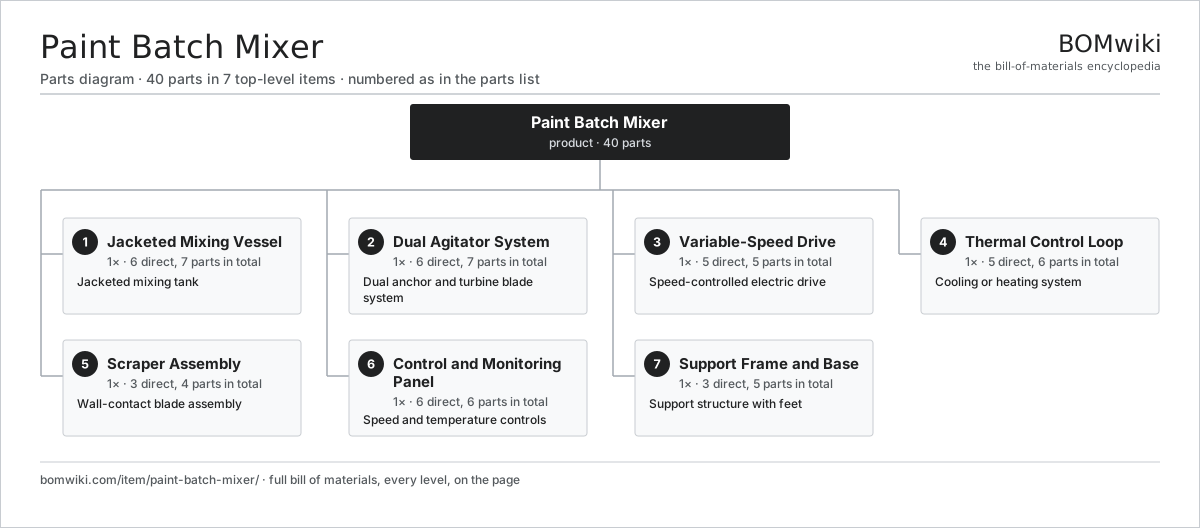
| # | Part | Qty | What it does |
|---|---|---|---|
| 1 | Jacketed Mixing Vessel 6 parts | 1× | Jacketed mixing tank |
| 2 | Dual Agitator System 6 parts | 1× | Dual anchor and turbine blade system |
| 3 | Variable-Speed Drive 5 parts | 1× | Speed-controlled electric drive |
| 4 | Thermal Control Loop 5 parts | 1× | Cooling or heating system |
| 5 | Scraper Assembly 3 parts | 1× | Wall-contact blade assembly |
| 6 | Control and Monitoring Panel 6 parts | 1× | Speed and temperature controls |
| 7 | Support Frame and Base 3 parts | 1× | Support structure with feet |
3D model
No 3D model yet. Have a CAD file of this? Add a 3D model. STL renders right on this page; STEP, FreeCAD, and OpenSCAD sources are welcome too (openly licensed, like all 3D models on BOMwiki).
Build & assembly graph
expand / collapse · shared sub-assemblies converge · links to related products · est. labourTap an assembly to expand/collapse · tap a part to open it · use “Open page” for any node · drag to pan, scroll to zoom.
Bill of materials for Paint Batch Mixer
7 top-level lines · 41 rows shown · 40 parts total · indented to 3 levels| # | Item / sub-assembly | Part no. | Qty/assy | Ext. qty | Parts | Type |
|---|---|---|---|---|---|---|
| 1 | Jacketed Mixing Vessel 6 parts | paint-batch-mixer-vessel | 1× | 1 | 7 | assembly |
| 1.1 | Stainless Steel Tank Body | paint-batch-mixer-vessel-body | 1× | 1 | · | part |
| 1.2 | Double-Wall Jacket | paint-batch-mixer-vessel-jacket | 1× | 1 | · | part |
| 1.3 | Access Lid | paint-batch-mixer-vessel-lid | 1× | 1 | · | part |
| 1.4 | Discharge Ball Valve | paint-batch-mixer-outlet-valve | 1× | 1 | · | part |
| 1.5 | Ingredient Addition Port | paint-batch-mixer-inlet-port | 1× | 1 | · | part |
| 1.6 | O-Ring Set | oring-set | 2× | 2 | · | part |
| 2 | Dual Agitator System 6 parts | paint-batch-mixer-agitator-assembly | 1× | 1 | 7 | assembly |
| 2.1 | Drive Shaft | paint-batch-mixer-central-shaft | 1× | 1 | · | part |
| 2.2 | Anchor Blade | paint-batch-mixer-anchor-blade | 1× | 1 | · | part |
| 2.3 | Turbine Impeller | paint-batch-mixer-turbine-impeller | 1× | 1 | · | part |
| 2.4 | Spring Scraper Ring | paint-batch-mixer-scraper-ring | 1× | 1 | · | part |
| 2.5 | Ball Bearing | ball-bearing | 2× | 2 | · | part |
| 2.6 | Oil Seal | oil-seal | 1× | 1 | · | part |
| 3 | Variable-Speed Drive 5 parts | paint-batch-mixer-motor-gearbox | 1× | 1 | 5 | assembly |
| 3.1 | Three-Phase Motor | paint-batch-mixer-three-phase-motor | 1× | 1 | · | part |
| 3.2 | Variable-Frequency Drive | paint-batch-mixer-vfd | 1× | 1 | · | part |
| 3.3 | Helical Gearbox | paint-batch-mixer-gearbox | 1× | 1 | · | part |
| 3.4 | Flexible Coupling | paint-batch-mixer-coupling | 1× | 1 | · | part |
| 3.5 | Connector | connector | 1× | 1 | · | part |
| 4 | Thermal Control Loop 5 parts | paint-batch-mixer-jacket-loop | 1× | 1 | 6 | assembly |
| 4.1 | Chiller/Heater Unit | paint-batch-mixer-chiller-heater | 1× | 1 | · | part |
| 4.2 | Circulation Pump | paint-batch-mixer-circulation-pump | 1× | 1 | · | part |
| 4.3 | Jacket Hose Assembly | paint-batch-mixer-jacket-hose | 2× | 2 | · | part |
| 4.4 | Temperature Gauge | paint-batch-mixer-thermometer | 1× | 1 | · | part |
| 4.5 | Pressure Sensor | pressure-sensor | 1× | 1 | · | part |
| 5 | Scraper Assembly 3 parts | paint-batch-mixer-scrapers | 1× | 1 | 4 | assembly |
| 5.1 | Scraper Finger | paint-batch-mixer-scraper-blade | 2× | 2 | · | part |
| 5.2 | Compression Spring Set | paint-batch-mixer-spring-set | 1× | 1 | · | part |
| 5.3 | Wear-Strip Insert | paint-batch-mixer-wear-plate | 1× | 1 | · | part |
| 6 | Control and Monitoring Panel 6 parts | paint-batch-mixer-control-panel | 1× | 1 | 6 | assembly |
| 6.1 | Speed Potentiometer | paint-batch-mixer-speed-potentiometer | 1× | 1 | · | part |
| 6.2 | RTD Temperature Display | paint-batch-mixer-temperature-gauge | 1× | 1 | · | part |
| 6.3 | Digital Process Timer | paint-batch-mixer-timer | 1× | 1 | · | part |
| 6.4 | Emergency Stop Button | paint-batch-mixer-estop-button | 1× | 1 | · | part |
| 6.5 | Four-Digit Display | paint-batch-mixer-hmi-display | 1× | 1 | · | part |
| 6.6 | Bare PCB | pcb-bare | 1× | 1 | · | part |
| 7 | Support Frame and Base 3 parts | paint-batch-mixer-frame | 1× | 1 | 5 | assembly |
| 7.1 | Welded Frame Structure | paint-batch-mixer-frame-body | 1× | 1 | · | part |
| 7.2 | Vibration Isolation Foot | paint-batch-mixer-isolation-feet | 3× | 3 | · | part |
| 7.3 | Drip Pan Assembly | paint-batch-mixer-drain-pan | 1× | 1 | · | part |
Something wrong in this list? Report a problem with this BOM.
Related products
same domain, ranked by shared parts Decanter Centrifuge
172 parts · shares 5 with this page
Gravimetric Plastics Blender
139 parts · shares 5 with this page
Hammer Mill
790 parts · shares 5 with this page
High-Speed Disperser
28 parts · shares 5 with this page
Decanter Centrifuge
172 parts · shares 5 with this page
Gravimetric Plastics Blender
139 parts · shares 5 with this page
Hammer Mill
790 parts · shares 5 with this page
High-Speed Disperser
28 parts · shares 5 with this page
 Industrial Parts Washer
423 parts · shares 5 with this page
Industrial Parts Washer
423 parts · shares 5 with this page
Sourcing: possible vendors
Browse the supplier directory → Prices, MOQ, and lead times are algorithmic estimates, not quotes, and not claims about these companies. Company mappings are curated by keyword; est. price band $5k–$2M. How estimates work| Vendor | HQ | Specialty | MOQ | Lead time |
|---|---|---|---|---|
| atlascopco.com ↗ | Stockholm, SE | Compressors & industrial | 10 units | 12–20 wks |
|
🇦🇹Andritz
andritz.com ↗
|
Graz, AT | Process plants & machinery | 10 units | 12–20 wks |
| buhlergroup.com ↗ | Uzwil, CH | Food & materials processing | 10 units | 12–20 wks |
| gea.com ↗ | Düsseldorf, DE | Process technology | 10 units | 12–20 wks |
| mhi.com ↗ | Tokyo, JP | Heavy machinery | 10 units | 12–20 wks |
1,169-word article