Laser Plastic Welding Machine
ProductOverview
A laser plastic welding machine joins two thermoplastic parts using a beam of near-infrared light instead of friction or a hot tool. It relies on a simple optical trick: the upper part is made of plastic that the laser passes straight through, and the lower part is made of plastic that absorbs the laser. The beam from the Laser Source travels through the Beam Delivery optics, passes through the clear top part, and is absorbed at the joint surface of the bottom part. That surface heats and melts, conducts heat into the clear part above it, and the two faces fuse while the Clamping System holds them together. The Motion Stage traces the weld path, the Control Cabinet runs the recipe, and the Laser Enclosure keeps the cell laser-safe.
The result is a clean weld with no flash, no vibration, and no marking of the visible surface, which is why the method is used for medical devices, electronics housings, and automotive sensors.
How it works
The whole process is called through-transmission welding because the energy is delivered through one part and absorbed in the other. The Diode Stack emits light at a wavelength around 940 to 980 nanometres. Natural plastic is largely transparent at this wavelength, while plastic loaded with a small amount of carbon black or a special infrared dye absorbs it strongly. So the top part is left clear and the bottom part is darkened, and the beam deposits its energy exactly at the interface where the weld is wanted.
Heat conducts a short distance into both faces, a thin layer melts on each side, and because the Clamping System is pressing the parts together the two melt films mix and bond. The clamp force matters more here than in any other plastic welding method, because the laser cannot bridge an air gap: wherever the parts are not touching, the energy simply does not couple across. The Clamp Load Cell confirms the joint is closed before the beam fires.
Laser source and beam delivery
The Laser Source is a diode laser, chosen for efficiency and long life. Its output is set by the Laser Driver as a precise current, since weld energy is power multiplied by exposure time. The Cooling Plate holds the diodes at a stable temperature so wavelength and power do not drift, and the Power Monitor samples the actual output on every weld. The beam runs down the Delivery Fiber to the head, where the Collimator straightens it and the Focus Lens sets the spot. A Galvo Scanner can steer the focused spot rapidly across the joint, which enables quasi-simultaneous welding where the whole contour is heated almost at once by sweeping it many times per second.
Welding strategies
There are three common strategies. Contour welding moves the spot once around the joint, with the Motion Stage or the galvo carrying the beam along the path, and suits long or large contours. Quasi-simultaneous welding scans the galvo over the whole contour repeatedly so the entire joint melts together, which lets the parts settle and close gaps as they weld. Simultaneous welding uses a shaped beam or a mask to expose the whole joint at once for the shortest cycle. The machine here supports contour and scanned strategies through its Galvo Scanner and Motion Stage, the latter built from an X Axis and Y Axis driven by a Servo Motor on a Ball Screw over Linear Guide Rail rails.
Clamping and monitoring
The Glass Platen is the part that makes laser welding distinctive: a transparent plate driven by the Clamp Cylinder presses the top part down while letting the beam through. Process monitoring is strong because the weld is contactless. The Pyrometer reads the melt temperature through the same optical path and lets the Laser Controller trim power in closed loop, while the Power Monitor verifies delivered energy. The PLC sequences load, clamp, weld, and unload, gating the beam behind the interlocks, and presents the recipe on the LCD Panel.
Materials, safety, and use
Laser welding works with most engineering thermoplastics, including PP, PA, PC, ABS, PMMA and even PEEK, as long as the transmitting and absorbing pair is correctly chosen. Clear-to-clear welds are possible with special infrared-absorbing additives placed only at the joint. Because the beam is invisible and harmful, the Laser Enclosure is a light-tight Class-1 cabinet with a Viewing Window filtered to the wavelength and a Door Interlock that cuts the laser if opened, plus an Fume Extractor for the small amount of vapour the weld releases. The method is preferred where the joint must be hidden, particle-free, and dimensionally exact, such as drug-delivery devices, microfluidic parts, and electronic enclosures, applications where the motion of vibration welding or the flash of hot-plate welding would be unacceptable.
Laser Plastic Welding Machine parts and their functions
6 top-level parts · 105 parts in total · full bill of materials below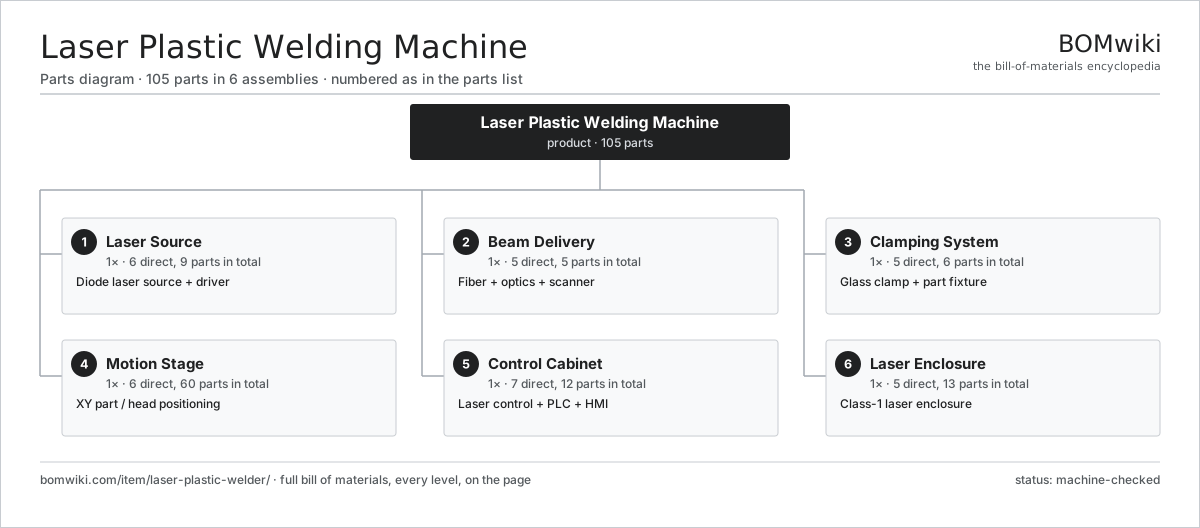
| # | Part | Qty | What it does |
|---|---|---|---|
| 1 | Laser Source 6 parts | 1× | Diode laser source + driver |
| 2 | Beam Delivery 5 parts | 1× | Fiber + optics + scanner |
| 3 | Clamping System 5 parts | 1× | Glass clamp + part fixture |
| 4 | Motion Stage 6 parts | 1× | XY part / head positioning |
| 5 | Control Cabinet 7 parts | 1× | Laser control + PLC + HMI |
| 6 | Laser Enclosure 5 parts | 1× | Class-1 laser enclosure |
3D model
No 3D model yet. Have a CAD file of this? Add a 3D model — STL renders right on this page; STEP, FreeCAD, and OpenSCAD sources are welcome too (openly licensed, like all 3D models on BOMwiki).
Build & assembly graph
expand / collapse · shared sub-assemblies converge · links to related products · est. labourTap an assembly to expand/collapse · tap a part to open it · use “Open page” for any node · drag to pan, scroll to zoom.
Bill of materials for Laser Plastic Welding Machine
6 top-level lines · 44 rows shown · 105 parts total · indented to 3 levels| # | Item / sub-assembly | Part no. | Qty/assy | Ext. qty | Parts | Type |
|---|---|---|---|---|---|---|
| 1 | Laser Source 6 parts | lpw-laser-source | 1× | 1 | 9 | assembly |
| 1.1 | Diode Stack | lpw-diode-stack | 1× | 1 | · | part |
| 1.2 | Laser Driver | lpw-laser-driver | 1× | 1 | · | part |
| 1.3 | Cooling Plate | lpw-cooling-plate | 1× | 1 | · | part |
| 1.4 | Power Monitor | lpw-power-monitor | 1× | 1 | · | part |
| 1.5 | Interlock Shutter | lpw-interlock-shutter | 1× | 1 | · | part |
| 1.6 | Connector | connector | 4× | 4 | · | part |
| 2 | Beam Delivery 5 parts | lpw-beam-delivery | 1× | 1 | 5 | assembly |
| 2.1 | Delivery Fiber | lpw-delivery-fiber | 1× | 1 | · | part |
| 2.2 | Collimator | lpw-collimator | 1× | 1 | · | part |
| 2.3 | Galvo Scanner | lpw-galvo-scanner | 1× | 1 | · | part |
| 2.4 | Focus Lens | lpw-focus-lens | 1× | 1 | · | part |
| 2.5 | Protective Window | lpw-protective-window | 1× | 1 | · | part |
| 3 | Clamping System 5 parts | lpw-clamping-system | 1× | 1 | 6 | assembly |
| 3.1 | Glass Platen | lpw-glass-platen | 1× | 1 | · | part |
| 3.2 | Clamp Cylinder | lpw-clamp-cylinder | 2× | 2 | · | part |
| 3.3 | Part Fixture | lpw-part-fixture | 1× | 1 | · | part |
| 3.4 | Clamp Load Cell | lpw-clamp-load-cell | 1× | 1 | · | part |
| 3.5 | O-Ring Set | oring-set | 1× | 1 | · | part |
| 4 | Motion Stage 6 parts | lpw-motion-stage | 1× | 1 | 60 | assembly |
| 4.1 | X Axis | lpw-x-axis | 1× | 1 | · | part |
| 4.2 | Y Axis | lpw-y-axis | 1× | 1 | · | part |
| 4.3 | Servo Motor 4 parts | servo-motor | 2× | 2 | 24 | assembly |
| 4.3.1 | Stator Assembly 3 parts + deeper › | stator-assembly | 1× | 2 | 3 | assembly |
| 4.3.2 | Rotor Assembly 4 parts + deeper › | rotor-assembly | 1× | 2 | 19 | assembly |
| 4.3.3 | Encoder | encoder | 1× | 2 | · | part |
| 4.3.4 | Motor Housing | motor-housing | 1× | 2 | · | part |
| 4.4 | Ball Screw | ball-screw | 2× | 2 | · | part |
| 4.5 | Linear Guide Rail | linear-guide | 4× | 4 | · | part |
| 4.6 | Limit Switch | limit-switch | 4× | 4 | · | part |
| 5 | Control Cabinet 7 parts | lpw-control-cabinet | 1× | 1 | 12 | assembly |
| 5.1 | Laser Controller | lpw-laser-controller | 1× | 1 | · | part |
| 5.2 | PLC | lpw-plc | 1× | 1 | · | part |
| 5.3 | LCD Panel | lcd-panel | 1× | 1 | · | part |
| 5.4 | Power Supply | power-supply | 1× | 1 | · | part |
| 5.5 | Pyrometer | lpw-pyrometer | 1× | 1 | · | part |
| 5.6 | Relay | relay | 6× | 6 | · | part |
| 5.7 | Wire Bundle | wire-bundle | 1× | 1 | · | part |
| 6 | Laser Enclosure 5 parts | lpw-enclosure | 1× | 1 | 13 | assembly |
| 6.1 | Cabinet Frame | lpw-cabinet-frame | 1× | 1 | · | part |
| 6.2 | Sheet Metal Panel | sheet-panel | 8× | 8 | · | part |
| 6.3 | Viewing Window | lpw-viewing-window | 1× | 1 | · | part |
| 6.4 | Door Interlock | lpw-door-interlock | 2× | 2 | · | part |
| 6.5 | Fume Extractor | lpw-fume-extractor | 1× | 1 | · | part |
Related products
same domain, ranked by shared parts Industrial 3D Printer
218 parts · shares 20 with this page
Industrial 3D Printer
218 parts · shares 20 with this page
 Injection Molding Machine
292 parts · shares 18 with this page
Automated Paint Spray Line
2,003 parts · shares 20 with this page
Injection Molding Machine
292 parts · shares 18 with this page
Automated Paint Spray Line
2,003 parts · shares 20 with this page
 Industrial Ultrasonic Cleaner
787 parts · shares 20 with this page
Micro Injection Molding Machine
704 parts · shares 20 with this page
Industrial Ultrasonic Cleaner
787 parts · shares 20 with this page
Micro Injection Molding Machine
704 parts · shares 20 with this page
 Thermal Spray Coating System
866 parts · shares 20 with this page
Thermal Spray Coating System
866 parts · shares 20 with this page
Sourcing: possible vendors
Prices, MOQ, and lead times are algorithmic estimates, not quotes, and not claims about these companies. Company mappings are curated by keyword; est. price band $5k–$2M. How estimates work| Vendor | HQ | Specialty | MOQ | Lead time |
|---|---|---|---|---|
| atlascopco.com ↗ | Stockholm, SE | Compressors & industrial | 10 units | 12–20 wks |
|
🇦🇹Andritz
andritz.com ↗
|
Graz, AT | Process plants & machinery | 10 units | 12–20 wks |
| buhlergroup.com ↗ | Uzwil, CH | Food & materials processing | 10 units | 12–20 wks |
| gea.com ↗ | Düsseldorf, DE | Process technology | 10 units | 12–20 wks |
| mhi.com ↗ | Tokyo, JP | Heavy machinery | 10 units | 12–20 wks |
836-word article