Tire Curing Press
ProductOverview
A tire curing press is a large hydraulically clamped machine that applies heat, pressure, and precise mold geometry to a green (uncured) tire, initiating vulcanization through a chemical reaction between rubber and sulfur. The Mold Container consists of upper and lower steel platens heated to 160–185 °C and pressed together with forces up to 3000 kN. Inside, an inflatable Bladder Mechanism pressurizes from 5–10 bar, holding the green tire tightly against the mold walls so that tread, sidewall, and internal patterns are imprinted with minimal distortion.
Heat is supplied via saturated steam flowing through internal galleries in the Steam System. Temperature is controlled to within ±2 °C by a Steam Regulator and monitored by multiple Temperature Sensors networked to the Control System. Once vulcanization is complete, the mold opens, and a Loader-Unloader arm removes the finished tire. Compressed nitrogen and a Cooling Blower rapidly cool the tire and mold in preparation for the next cycle.
The press is found at every commercial tire factory and operates continuously in production, running 20–30 cycles per shift per cavity. Different tire sizes require different molds, so tire plants typically house banks of 20–100 presses, each fitted with molds for specific tire sizes.
How it works
A green tire arrives on a cart and is manually or robotically placed onto the Load Gripper of the Loader-Unloader. An operator or line controller enters the tire size and compound type into the Control System HMI, and the PLC loads the corresponding cure recipe from memory, this specifies pressure profile, temperature setpoints, and time steps.
The loader arm pivots via the Load Arm Cylinder, rotating the tire on the Load Spindle to center it on the mold cavity axis. The gripper releases, and the Clamp Cylinder, two large bore cylinders, one on each side, extend and apply clamping force to draw the Upper Platen down onto the Lower Platen. The clamping force may reach 1500–3000 kN depending on tire size.
Once the mold is closed, the Control System activates the Steam System. The Steam Boiler, already at operating temperature, supplies pressurized steam through the Steam Manifold, which routes it through heating galleries in both platens and around the Mold Cavity Insert. Simultaneously, compressed nitrogen from the Nitrogen Cylinder inflates the Bladder Envelope to 6–8 bar via the Bladder Stem. The internal pressure forces the rubber against the mold walls, ensuring crisp tread pattern definition and sidewall marking.
The Temperature Sensors report platen temperature back to the PLC every 2–5 seconds. If temperature lags below setpoint, the PLC signals the Steam Regulator to increase flow. If temperature climbs above setpoint, the Steam Traps open fully to drain condensate and cool the mold. Vulcanization proceeds as a function of time and temperature; at 180 °C, most passenger tire compounds require 10–15 minutes. OTR tires and thicker compounds require 20–30 minutes.
When the PLC timer expires, the Control System triggers the Bladder Release Valve, which vents the bladder to atmosphere. The Cooling Blower ramps to high speed, and the Cooling Nozzles spray cold ambient air onto the tire and mold exterior. Simultaneously, a small flow of nitrogen or compressed air is sometimes applied internally to help peel the tire away from the mold (pneumatic assist).
After 2–5 minutes of cooling, the Clamp Cylinders retract and the Upper Platen lifts. The loader arm advances, the Load Gripper re-engages the tire sidewall, and the gripper retracts the tire from the mold. The spindle rotates the tire off-center, and the arm rotates back. The finished tire rolls or is conveyed onto the Unload Conveyor into a vulcanizate inspection lane.
The mold is now ready for the next tire. The Hydraulic System, its Hydraulic Pump driven by a 22 kW motor, has been supplying all clamp and loader motion throughout. The pump is variable-displacement: when the press is idle (mold open), it unloads to tank at zero pressure, saving energy. During clamping and opening, it supplies high flow and moderate pressure. The Relief Valve limits system pressure to 210–250 bar, protecting lines and cylinders.
Energy and Cooling
The largest energy consumer is the Steam Boiler:
- Boiler heater: 60–100 kW electric resistance heating water to steam continuously
- Hydraulic pump motor: 22 kW driving clamping and loader cylinders
- Cooling blower: 5 kW fan cooling tire and mold
- PLC and controls: 2–5 kW
Total site load: 90–130 kW per press per cycle. A modern 500-ton tire plant may have 30–50 active presses, requiring dedicated steam infrastructure and 5–10 MW electrical service.
Cooling is the bottleneck in high-speed production. The cooler the post-cure cooling, the faster the next cycle can begin. Many plants supplement the Cooling Blower with water-cooled Cooling Nozzles or evaporative cooling systems to drop mold temperature from 180 °C to 50 °C in 2–3 minutes instead of 5–10 minutes.
Tire Curing Press parts and their functions
8 top-level parts · 84 parts in total · full bill of materials below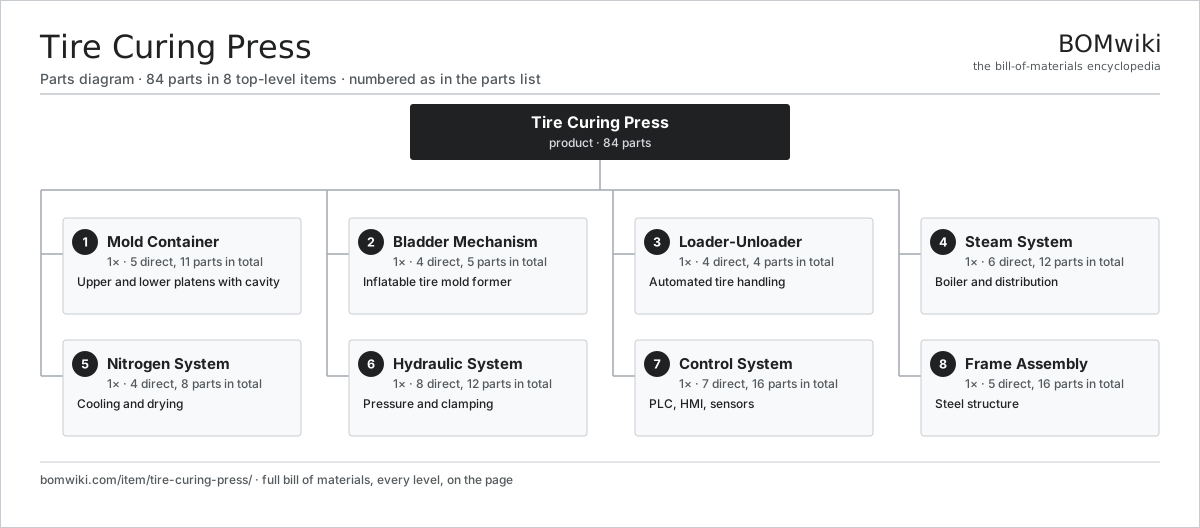
| # | Part | Qty | What it does |
|---|---|---|---|
| 1 | Mold Container 5 parts | 1× | Upper and lower platens with cavity |
| 2 | Bladder Mechanism 4 parts | 1× | Inflatable tire mold former |
| 3 | Loader-Unloader 4 parts | 1× | Automated tire handling |
| 4 | Steam System 6 parts | 1× | Boiler and distribution |
| 5 | Nitrogen System 4 parts | 1× | Cooling and drying |
| 6 | Hydraulic System 8 parts | 1× | Pressure and clamping |
| 7 | Control System 7 parts | 1× | PLC, HMI, sensors |
| 8 | Frame Assembly 5 parts | 1× | Steel structure |
3D model
No 3D model yet. Have a CAD file of this? Add a 3D model. STL renders right on this page; STEP, FreeCAD, and OpenSCAD sources are welcome too (openly licensed, like all 3D models on BOMwiki).
Build & assembly graph
expand / collapse · shared sub-assemblies converge · links to related products · est. labourTap an assembly to expand/collapse · tap a part to open it · use “Open page” for any node · drag to pan, scroll to zoom.
Bill of materials for Tire Curing Press
8 top-level lines · 51 rows shown · 84 parts total · indented to 3 levels| # | Item / sub-assembly | Part no. | Qty/assy | Ext. qty | Parts | Type |
|---|---|---|---|---|---|---|
| 1 | Mold Container 5 parts | tire-curing-press-mold-container | 1× | 1 | 11 | assembly |
| 1.1 | Upper Platen | tire-curing-press-upper-platen | 1× | 1 | · | part |
| 1.2 | Lower Platen | tire-curing-press-lower-platen | 1× | 1 | · | part |
| 1.3 | Mold Cavity Insert | tire-curing-press-mold-cavity | 1× | 1 | · | part |
| 1.4 | Platen Guide Pin | tire-curing-press-platen-guide-pin | 4× | 4 | · | part |
| 1.5 | Cartridge Heater | tire-curing-press-mold-heating-cartridge | 4× | 4 | · | part |
| 2 | Bladder Mechanism 4 parts | tire-curing-press-bladder-mechanism | 1× | 1 | 5 | assembly |
| 2.1 | Bladder Envelope | tire-curing-press-bladder-envelope | 1× | 1 | · | part |
| 2.2 | Bladder Stem | tire-curing-press-bladder-stem | 1× | 1 | · | part |
| 2.3 | Bladder Support Rod | tire-curing-press-bladder-support-rod | 2× | 2 | · | part |
| 2.4 | Bladder Release Valve | tire-curing-press-bladder-release-valve | 1× | 1 | · | part |
| 3 | Loader-Unloader 4 parts | tire-curing-press-loader-unloader | 1× | 1 | 4 | assembly |
| 3.1 | Load Arm | tire-curing-press-load-arm | 1× | 1 | · | part |
| 3.2 | Load Gripper | tire-curing-press-load-gripper | 1× | 1 | · | part |
| 3.3 | Load Spindle | tire-curing-press-load-spindle | 1× | 1 | · | part |
| 3.4 | Unload Conveyor | tire-curing-press-unload-conveyor | 1× | 1 | · | part |
| 4 | Steam System 6 parts | tire-curing-press-steam-system | 1× | 1 | 12 | assembly |
| 4.1 | Steam Boiler | tire-curing-press-boiler | 1× | 1 | · | part |
| 4.2 | Steam Regulator | tire-curing-press-steam-regulator | 2× | 2 | · | part |
| 4.3 | Steam Manifold | tire-curing-press-steam-distribution-block | 1× | 1 | · | part |
| 4.4 | Steam Trap | tire-curing-press-steam-trap | 4× | 4 | · | part |
| 4.5 | Steam Hose Assembly | tire-curing-press-steam-hose | 1× | 1 | · | part |
| 4.6 | Temperature Sensor | tire-curing-press-steam-thermocouple | 3× | 3 | · | part |
| 5 | Nitrogen System 4 parts | tire-curing-press-nitrogen-system | 1× | 1 | 8 | assembly |
| 5.1 | Nitrogen Cylinder | tire-curing-press-nitrogen-bottle | 2× | 2 | · | part |
| 5.2 | Nitrogen Regulator | tire-curing-press-nitrogen-regulator | 1× | 1 | · | part |
| 5.3 | Cooling Blower | tire-curing-press-cool-air-blower | 1× | 1 | · | part |
| 5.4 | Cooling Nozzle | tire-curing-press-cool-air-nozzle | 4× | 4 | · | part |
| 6 | Hydraulic System 8 parts | tire-curing-press-hydraulic-system | 1× | 1 | 12 | assembly |
| 6.1 | Hydraulic Pump | tire-curing-press-hydraulic-pump | 1× | 1 | · | part |
| 6.2 | Hydraulic Motor | tire-curing-press-hydraulic-motor | 1× | 1 | · | part |
| 6.3 | Clamp Cylinder | tire-curing-press-main-clamp-cylinder | 2× | 2 | · | part |
| 6.4 | Load Arm Cylinder | tire-curing-press-load-arm-cylinder | 1× | 1 | · | part |
| 6.5 | Directional Valve | tire-curing-press-directional-valve | 3× | 3 | · | part |
| 6.6 | Relief Valve | tire-curing-press-pressure-relief-valve | 2× | 2 | · | part |
| 6.7 | Hydraulic Accumulator | tire-curing-press-hydraulic-accumulator | 1× | 1 | · | part |
| 6.8 | Hydraulic Reservoir | tire-curing-press-hydraulic-reservoir | 1× | 1 | · | part |
| 7 | Control System 7 parts | tire-curing-press-control-system | 1× | 1 | 16 | assembly |
| 7.1 | Microcontroller | mcu | 1× | 1 | · | part |
| 7.2 | LCD Panel | lcd-panel | 1× | 1 | · | part |
| 7.3 | Pressure Sensor | pressure-sensor | 4× | 4 | · | part |
| 7.4 | Encoder | encoder | 1× | 1 | · | part |
| 7.5 | Relay | relay | 6× | 6 | · | part |
| 7.6 | Bare PCB | pcb-bare | 1× | 1 | · | part |
| 7.7 | Thermal Fuse | thermal-fuse | 2× | 2 | · | part |
| 8 | Frame Assembly 5 parts | tire-curing-press-frame | 1× | 1 | 16 | assembly |
| 8.1 | Base Plate | tire-curing-press-base-plate | 1× | 1 | · | part |
| 8.2 | Side Frame | tire-curing-press-side-frame | 2× | 2 | · | part |
| 8.3 | Top Frame | tire-curing-press-top-frame | 1× | 1 | · | part |
| 8.4 | Guide Column | tire-curing-press-platen-guide-column | 4× | 4 | · | part |
| 8.5 | Vibration Damper | tire-curing-press-vibration-damper | 8× | 8 | · | part |
Something wrong in this list? Report a problem with this BOM.
Related products
same domain, ranked by shared parts Industrial FDM Printer
98 parts · shares 5 with this page
Industrial FDM Printer
98 parts · shares 5 with this page
 Briquetting Press
92 parts · shares 3 with this page
Nail Polish Filling Machine
82 parts · shares 3 with this page
Briquetting Press
92 parts · shares 3 with this page
Nail Polish Filling Machine
82 parts · shares 3 with this page
 Cosmetic Powder Press
92 parts · shares 3 with this page
Lipstick Molding Machine
131 parts · shares 3 with this page
Cosmetic Powder Press
92 parts · shares 3 with this page
Lipstick Molding Machine
131 parts · shares 3 with this page
Sourcing: possible vendors
Browse the supplier directory → Prices, MOQ, and lead times are algorithmic estimates, not quotes, and not claims about these companies. Company mappings are curated by keyword; est. price band $5k–$2M. How estimates work| Vendor | HQ | Specialty | MOQ | Lead time |
|---|---|---|---|---|
| atlascopco.com ↗ | Stockholm, SE | Compressors & industrial | 10 units | 12–20 wks |
|
🇦🇹Andritz
andritz.com ↗
|
Graz, AT | Process plants & machinery | 10 units | 12–20 wks |
| buhlergroup.com ↗ | Uzwil, CH | Food & materials processing | 10 units | 12–20 wks |
| gea.com ↗ | Düsseldorf, DE | Process technology | 10 units | 12–20 wks |
| mhi.com ↗ | Tokyo, JP | Heavy machinery | 10 units | 12–20 wks |
957-word article