Plastic Granulator
ProductAlso known as: Plastics Granulator
Overview
A plastic granulator reduces plastic scrap to small flakes called regrind so the material can be fed back into a molding or extrusion process instead of being thrown away. Scrap is dropped into the Feed Hopper and falls onto a spinning Knife Rotor inside the Cutting Chamber. The rotor knives shear the plastic against fixed bed knives, and the pieces stay in the chamber until they are small enough to drop through the Sizing Screen into the Discharge Unit unit. The Drive Package supplies the torque, the Control Panel manages the motor and safety logic, and the Frame and Enclosure carries it all and damps the noise.
Granulators sit beside injection molding machines to chop sprues and runners, run in central recycling rooms to handle reject parts and purgings, and form the first size-reduction step in many recycling lines. The principle is simple shearing, but the details of knife geometry, screen size, and rotor speed decide whether the output is clean uniform flake or a mix of dust and oversize chunks.
Feeding safely
The Feed Hopper is shaped to guide scrap down to the rotor while keeping hands and flying chips away from the knives. A welded Hopper Body forms the funnel, and a pair of Sound Baffle flaps muffle the cutting noise and stop fragments from being thrown back up the throat. A Feed Flap closes the path between drops, and a Interlock Switch stops the rotor whenever the hopper is opened for cleaning, because an exposed rotor turning at full speed is the most dangerous part of the machine.
The cutting chamber and rotor
Cutting happens where the Knife Rotor meets the Cutting Chamber. The heavy Chamber Housing holds two Bed Knife blades, and the rotor carries several Rotor Knife blades in Knife Holder clamps. As the Rotor Shaft turns, each rotor knife passes close to a bed knife and shears the plastic between them, much like a pair of scissors closing. The gap between moving and fixed knives is critical and is set with the Knife Adjuster screws: too wide and the plastic folds instead of cutting, too tight and the knives strike each other. A Flywheel on the shaft stores energy so the rotor carries through hard pieces without stalling, and Wear Liner plates protect the chamber walls from abrasion by filled or glass-reinforced scrap.
Drive and torque
Granulating tough or thick scrap takes high torque at moderate speed, which the Drive Package provides. A Main Motor turns the Motor Pulley, and two Drive Belt V-belts carry the power to the larger Rotor Pulley, giving a speed reduction and torque multiplication. The belts also act as a slip clutch of sorts: if a metal contaminant jams the rotor they slip and squeal rather than snapping the shaft, and the Belt Guard keeps the drive enclosed. Rotor speed is chosen for the material, since slow speeds reduce dust and heat on brittle plastics while higher speeds raise throughput on tough ones.
Sizing the regrind
The Sizing Screen decides how big the regrind comes out. A curved Screen Plate wraps under the rotor in a Screen Cradle, and plastic is recut again and again until each piece is small enough to pass through a hole. Hole size sets the flake size directly: a 5 mm screen makes fine regrind suited to blending back at a low percentage, while a 10 mm screen makes coarse flake that conveys easily. The screen is held by Screen Clamp fittings so it can be swapped quickly when the job changes. Once through the screen, regrind drops into the Discharge Unit unit, where it either collects in a Collection Bin or is carried off by a Evacuation Blower through a Cyclone Separator to a storage hopper.
Control and protection
The Control Panel panel starts and protects the rotor. A Motor Contactor switches the Main Motor, and a Overload Relay relay trips if the rotor stalls on a jam or draws too much current for too long. Safety Relay circuits tie the Interlock Switch into the start logic so the machine cannot run with the hopper or screen open. Because the rotor coasts for many seconds after power is cut, the logic also enforces a delay before any guard can be opened.
Materials, noise, and use
Granulators handle nearly every thermoplastic, from soft polyolefins like PP and PE through styrenics and ABS to rigid PVC and brittle filled compounds, with knife type and speed chosen to suit. Cutting is inherently loud, so the Frame and Enclosure carries acoustic Acoustic Foam panels and sits on Anti-Vibration Mount isolators to keep noise and vibration down. In a molding shop a small beside-the-press granulator returns sprues to the hopper within minutes; in a recycling plant a large central machine reduces baled or shredded scrap ahead of washing and pelletizing. The main maintenance task is knife care, since sharp Rotor Knife and Bed Knife edges make clean low-dust flake while dull ones generate fines and heat that can degrade the polymer.
Plastic Granulator parts and their functions
8 top-level parts · 83 parts in total · full bill of materials below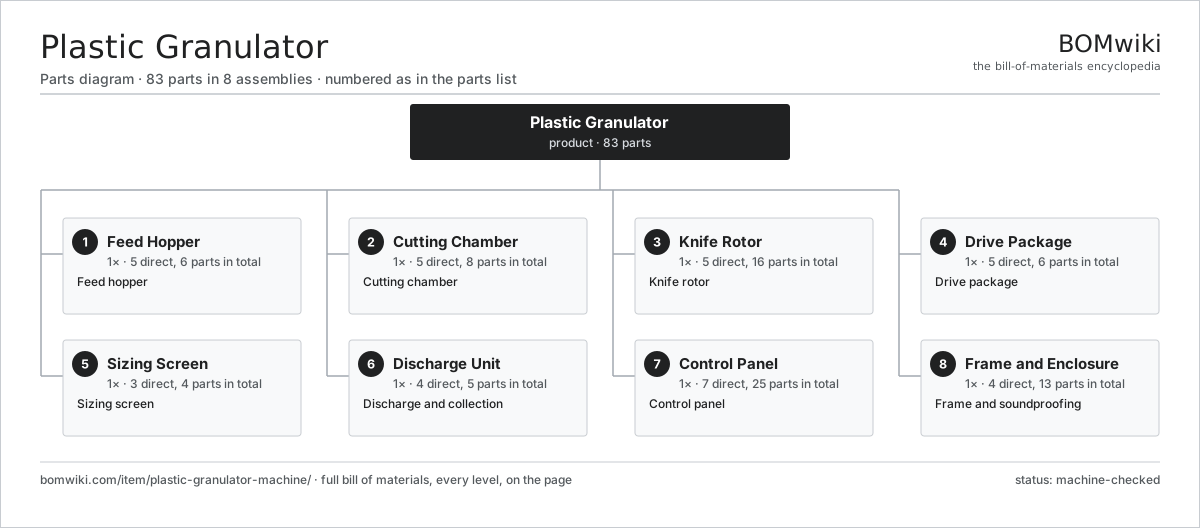
| # | Part | Qty | What it does |
|---|---|---|---|
| 1 | Feed Hopper 5 parts | 1× | Feed hopper |
| 2 | Cutting Chamber 5 parts | 1× | Cutting chamber |
| 3 | Knife Rotor 5 parts | 1× | Knife rotor |
| 4 | Drive Package 5 parts | 1× | Drive package |
| 5 | Sizing Screen 3 parts | 1× | Sizing screen |
| 6 | Discharge Unit 4 parts | 1× | Discharge and collection |
| 7 | Control Panel 7 parts | 1× | Control panel |
| 8 | Frame and Enclosure 4 parts | 1× | Frame and soundproofing |
3D model
No 3D model yet. Have a CAD file of this? Add a 3D model — STL renders right on this page; STEP, FreeCAD, and OpenSCAD sources are welcome too (openly licensed, like all 3D models on BOMwiki).
Build & assembly graph
expand / collapse · shared sub-assemblies converge · links to related products · est. labourTap an assembly to expand/collapse · tap a part to open it · use “Open page” for any node · drag to pan, scroll to zoom.
Bill of materials for Plastic Granulator
8 top-level lines · 46 rows shown · 83 parts total · indented to 3 levels| # | Item / sub-assembly | Part no. | Qty/assy | Ext. qty | Parts | Type |
|---|---|---|---|---|---|---|
| 1 | Feed Hopper 5 parts | plastic-granulator-machine-hopper | 1× | 1 | 6 | assembly |
| 1.1 | Hopper Body | plastic-granulator-machine-hopper-body | 1× | 1 | · | part |
| 1.2 | Sound Baffle | plastic-granulator-machine-sound-baffle | 2× | 2 | · | part |
| 1.3 | Feed Flap | plastic-granulator-machine-feed-flap | 1× | 1 | · | part |
| 1.4 | Interlock Switch | plastic-granulator-machine-safety-switch | 1× | 1 | · | part |
| 1.5 | Fastener Set | fastener-set | 1× | 1 | · | part |
| 2 | Cutting Chamber 5 parts | plastic-granulator-machine-cutting-chamber | 1× | 1 | 8 | assembly |
| 2.1 | Chamber Housing | plastic-granulator-machine-chamber-housing | 1× | 1 | · | part |
| 2.2 | Bed Knife | plastic-granulator-machine-bed-knife | 2× | 2 | · | part |
| 2.3 | Knife Adjuster | plastic-granulator-machine-knife-adjuster | 2× | 2 | · | part |
| 2.4 | Wear Liner | plastic-granulator-machine-wear-liner | 2× | 2 | · | part |
| 2.5 | Fastener Set | fastener-set | 1× | 1 | · | part |
| 3 | Knife Rotor 5 parts | plastic-granulator-machine-rotor | 1× | 1 | 16 | assembly |
| 3.1 | Rotor Shaft | plastic-granulator-machine-rotor-shaft | 1× | 1 | · | part |
| 3.2 | Rotor Knife | plastic-granulator-machine-rotor-knife | 6× | 6 | · | part |
| 3.3 | Knife Holder | plastic-granulator-machine-knife-holder | 6× | 6 | · | part |
| 3.4 | Ball Bearing | ball-bearing | 2× | 2 | · | part |
| 3.5 | Flywheel | plastic-granulator-machine-flywheel | 1× | 1 | · | part |
| 4 | Drive Package 5 parts | plastic-granulator-machine-drive | 1× | 1 | 6 | assembly |
| 4.1 | Main Motor | plastic-granulator-machine-motor | 1× | 1 | · | part |
| 4.2 | Drive Belt | drive-belt | 2× | 2 | · | part |
| 4.3 | Motor Pulley | plastic-granulator-machine-motor-pulley | 1× | 1 | · | part |
| 4.4 | Rotor Pulley | plastic-granulator-machine-rotor-pulley | 1× | 1 | · | part |
| 4.5 | Belt Guard | plastic-granulator-machine-belt-guard | 1× | 1 | · | part |
| 5 | Sizing Screen 3 parts | plastic-granulator-machine-screen | 1× | 1 | 4 | assembly |
| 5.1 | Screen Plate | plastic-granulator-machine-screen-plate | 1× | 1 | · | part |
| 5.2 | Screen Cradle | plastic-granulator-machine-screen-cradle | 1× | 1 | · | part |
| 5.3 | Screen Clamp | plastic-granulator-machine-screen-clamp | 2× | 2 | · | part |
| 6 | Discharge Unit 4 parts | plastic-granulator-machine-discharge | 1× | 1 | 5 | assembly |
| 6.1 | Collection Bin | plastic-granulator-machine-collection-bin | 1× | 1 | · | part |
| 6.2 | Evacuation Blower | plastic-granulator-machine-blower | 1× | 1 | · | part |
| 6.3 | Cyclone Separator | plastic-granulator-machine-cyclone | 1× | 1 | · | part |
| 6.4 | Water Hose | water-hose | 2× | 2 | · | part |
| 7 | Control Panel 7 parts | plastic-granulator-machine-control | 1× | 1 | 25 | assembly |
| 7.1 | Bare PCB | pcb-bare | 1× | 1 | · | part |
| 7.2 | Microcontroller | mcu | 1× | 1 | · | part |
| 7.3 | Motor Contactor | plastic-granulator-machine-contactor | 1× | 1 | · | part |
| 7.4 | Overload Relay | plastic-granulator-machine-overload | 1× | 1 | · | part |
| 7.5 | Relay | relay | 4× | 4 | · | part |
| 7.6 | Connector | connector | 16× | 16 | · | part |
| 7.7 | Wire Bundle | wire-bundle | 1× | 1 | · | part |
| 8 | Frame and Enclosure 4 parts | plastic-granulator-machine-frame | 1× | 1 | 13 | assembly |
| 8.1 | Base Frame | plastic-granulator-machine-base-frame | 1× | 1 | · | part |
| 8.2 | Sheet Metal Panel | sheet-panel | 4× | 4 | · | part |
| 8.3 | Acoustic Foam | plastic-granulator-machine-sound-foam | 4× | 4 | · | part |
| 8.4 | Anti-Vibration Mount | plastic-granulator-machine-mount-pad | 4× | 4 | · | part |
Related products
same domain, ranked by shared parts All-Electric Injection Molding Machine
851 parts · shares 6 with this page
Automated Paint Spray Line
2,003 parts · shares 6 with this page
All-Electric Injection Molding Machine
851 parts · shares 6 with this page
Automated Paint Spray Line
2,003 parts · shares 6 with this page
Sourcing: possible vendors
Prices, MOQ, and lead times are algorithmic estimates, not quotes, and not claims about these companies. Company mappings are curated by keyword; est. price band $5k–$2M. How estimates work| Vendor | HQ | Specialty | MOQ | Lead time |
|---|---|---|---|---|
| atlascopco.com ↗ | Stockholm, SE | Compressors & industrial | 10 units | 12–20 wks |
|
🇦🇹Andritz
andritz.com ↗
|
Graz, AT | Process plants & machinery | 10 units | 12–20 wks |
| buhlergroup.com ↗ | Uzwil, CH | Food & materials processing | 10 units | 12–20 wks |
| gea.com ↗ | Düsseldorf, DE | Process technology | 10 units | 12–20 wks |
| mhi.com ↗ | Tokyo, JP | Heavy machinery | 10 units | 12–20 wks |
956-word article