Hot-Dip Galvanizing Kettle
ProductOverview
A hot-dip galvanizing kettle is a large steel pot of molten zinc, held near 450C, into which cleaned steel parts are dipped so they come out sheathed in a tough zinc coating. The coating is metallurgically bonded: the iron in the steel reacts with the zinc to form a stack of iron-zinc alloy layers under a pure zinc outer skin, which is what makes hot-dip galvanizing last for decades outdoors. The kettle is the centre of a galvanizing plant that also cleans the steel, fluxes it, lowers it into the zinc, lifts it out, and captures the fume that comes off.
The pot itself is the Kettle Vessel, heated by the Furnace around it. Steel is prepared in the Pretreatment Line and lowered by the Dipping Hoist. The Dross and Ash System keeps the bath clean, the Fume System catches the smoke, the Zinc Feed tops the bath up, and the Control Cabinet holds the temperature steady.
The kettle and zinc bath
The Kettle Wall and Kettle Bottom are welded from special low-silicon, low-carbon boiler plate. Steel composition matters here because molten zinc slowly dissolves iron, and high silicon accelerates that attack, so a kettle made from the wrong plate can wear through in a year. A well-built kettle lasts eight to twelve years. The wall is braced with a Stiffener Rib grid so the static head of zinc, which can run to several hundred tonnes, does not bulge the plate at temperature.
The Zinc Bath is mostly special high-grade zinc with small additions: aluminium at a few hundredths of a percent brightens the coat and slows oxidation of the surface, and nickel suppresses the excessive alloy growth that reactive, high-silicon steels would otherwise cause. Bath temperature is read by a Bath Thermocouple set and the depth by a Level Probe, so the operator knows when to add zinc.
Heating the bath
The kettle sits inside the Furnace, a refractory chamber that heats the kettle wall from outside rather than putting flame on the zinc. The Furnace Shell holds a Refractory Lining of ceramic fibre and firebrick, and several Gas Burner units fire along the walls. The burners are high-velocity so their jets sweep the kettle face evenly and avoid local hot spots that would thin the steel. A Burner Train meters the gas and proves each flame with a Flame Rod before it keeps the gas on.
Because the kettle runs continuously, fuel is a major cost, so a Recuperator in the Flue Stack reclaims heat from the exhaust to preheat the combustion air fed by the Combustion Fan. That can cut gas use by a fifth.
Cleaning and fluxing
Zinc will not bond to dirty or scaled steel, so every part passes through the Pretreatment Line first. The Degrease Tank strips oil and paint in hot caustic, the Pickle Tank dissolves mill scale and rust in hydrochloric acid, and the Rinse Tank washes the acid off so it does not poison the flux. The steel then goes through the Flux Tank, a warm zinc ammonium chloride solution that leaves a film keeping the steel active until it meets the zinc. A Preflux Dryer drives off the water, because wet steel entering molten zinc flashes to steam and throws zinc out of the kettle.
Dipping and withdrawal
Parts are racked on a Dip Jig and lowered into the zinc by the Dipping Hoist. The Crane Bridge carries a Hoist Trolley whose Lift Drum, driven through the Hoist Gearbox, winds the Lift Cable runs. The jig is dipped at an angle so zinc fills hollow sections and air escapes, then held for one to six minutes until the part reaches bath temperature and the alloy layers form. On the way out the Tilt Frame tips the load so excess zinc drains back to the bath and the coat does not run.
Keeping the bath clean
Two byproducts have to be managed every shift. Iron that dissolves off the steel sinks as a heavy iron-zinc dross to the kettle floor, where it is lifted out with the Dross Grab or drawn off by the Dross Pump into a side Dross Kettle to cool for sale back to refiners. On the surface, zinc oxidises to a powdery ash that the Ash Skimmer drags off along the Skim Rail just before each dip so it does not print onto the coating.
Fume, feed, and control
When fluxed steel hits the zinc the flux burns off as a dense white zinc oxide plume, captured by the Fume Hood and pulled through the Baghouse by the Induced-Draft Fan, where a Filter Bag array traps the dust. Zinc consumed by the coating and the dross is replaced through the Zinc Feed, which slides fresh ingots down the Charge Ramp so they melt without splashing, while the Alloy Feeder trims the chemistry. Over it all, the Temperature Controller modulates the burners to hold the bath in a tight band, and the Burner Management keeps the firing safe. Kettles vary mainly in length, from short job-shop pots for fasteners and brackets to long pots that take full structural beams and lighting columns in one dip.
Hot-Dip Galvanizing Kettle parts and their functions
8 top-level parts · 574 parts in total · full bill of materials below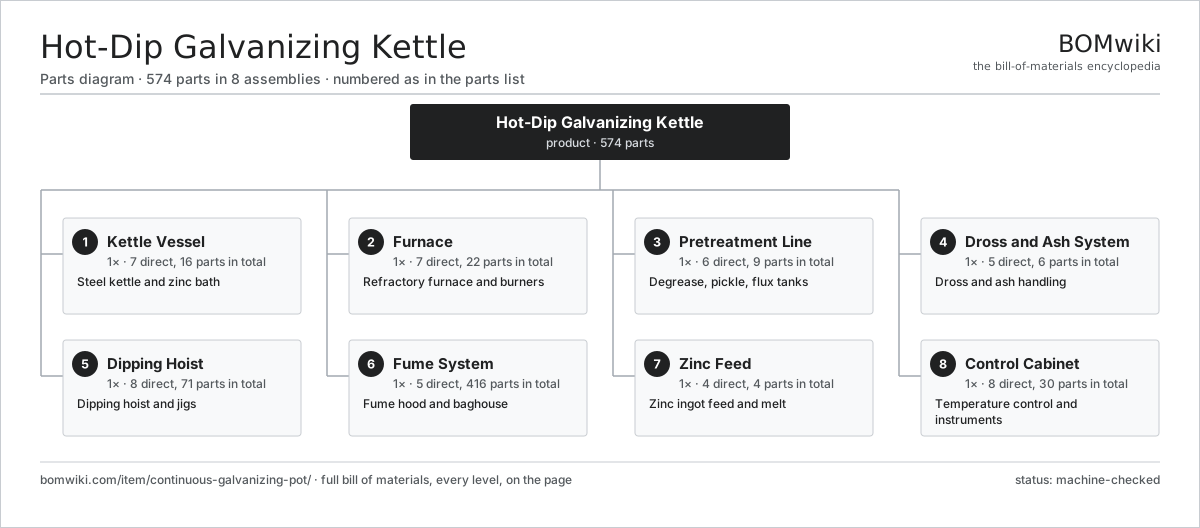
| # | Part | Qty | What it does |
|---|---|---|---|
| 1 | Kettle Vessel 7 parts | 1× | Steel kettle and zinc bath |
| 2 | Furnace 7 parts | 1× | Refractory furnace and burners |
| 3 | Pretreatment Line 6 parts | 1× | Degrease, pickle, flux tanks |
| 4 | Dross and Ash System 5 parts | 1× | Dross and ash handling |
| 5 | Dipping Hoist 8 parts | 1× | Dipping hoist and jigs |
| 6 | Fume System 5 parts | 1× | Fume hood and baghouse |
| 7 | Zinc Feed 4 parts | 1× | Zinc ingot feed and melt |
| 8 | Control Cabinet 8 parts | 1× | Temperature control and instruments |
3D model
No 3D model yet. Have a CAD file of this? Add a 3D model — STL renders right on this page; STEP, FreeCAD, and OpenSCAD sources are welcome too (openly licensed, like all 3D models on BOMwiki).
Build & assembly graph
expand / collapse · shared sub-assemblies converge · links to related products · est. labourTap an assembly to expand/collapse · tap a part to open it · use “Open page” for any node · drag to pan, scroll to zoom.
Bill of materials for Hot-Dip Galvanizing Kettle
8 top-level lines · 73 rows shown · 574 parts total · indented to 3 levels| # | Item / sub-assembly | Part no. | Qty/assy | Ext. qty | Parts | Type |
|---|---|---|---|---|---|---|
| 1 | Kettle Vessel 7 parts | continuous-galvanizing-pot-kettle-vessel | 1× | 1 | 16 | assembly |
| 1.1 | Kettle Wall | continuous-galvanizing-pot-kettle-wall | 1× | 1 | · | part |
| 1.2 | Kettle Bottom | continuous-galvanizing-pot-kettle-bottom | 1× | 1 | · | part |
| 1.3 | Zinc Bath | continuous-galvanizing-pot-zinc-bath | 1× | 1 | · | part |
| 1.4 | Freeboard Flange | continuous-galvanizing-pot-freeboard-flange | 1× | 1 | · | part |
| 1.5 | Stiffener Rib | continuous-galvanizing-pot-kettle-stiffener | 8× | 8 | · | part |
| 1.6 | Bath Thermocouple | continuous-galvanizing-pot-bath-thermocouple | 3× | 3 | · | part |
| 1.7 | Level Probe | continuous-galvanizing-pot-level-probe | 1× | 1 | · | part |
| 2 | Furnace 7 parts | continuous-galvanizing-pot-furnace | 1× | 1 | 22 | assembly |
| 2.1 | Furnace Shell | continuous-galvanizing-pot-furnace-shell | 1× | 1 | · | part |
| 2.2 | Refractory Lining | continuous-galvanizing-pot-refractory-lining | 1× | 1 | · | part |
| 2.3 | Gas Burner | continuous-galvanizing-pot-burner | 6× | 6 | · | part |
| 2.4 | Burner Train 4 parts | continuous-galvanizing-pot-burner-train | 1× | 1 | 11 | assembly |
| 2.4.1 | Gas Shutoff Valve | continuous-galvanizing-pot-gas-valve | 2× | 2 | · | part |
| 2.4.2 | Gas Regulator | continuous-galvanizing-pot-gas-regulator | 1× | 1 | · | part |
| 2.4.3 | Flame Rod | continuous-galvanizing-pot-flame-rod | 6× | 6 | · | part |
| 2.4.4 | Pressure Sensor | pressure-sensor | 2× | 2 | · | part |
| 2.5 | Recuperator | continuous-galvanizing-pot-recuperator | 1× | 1 | · | part |
| 2.6 | Flue Stack | continuous-galvanizing-pot-flue-stack | 1× | 1 | · | part |
| 2.7 | Combustion Fan | continuous-galvanizing-pot-combustion-fan | 1× | 1 | · | part |
| 3 | Pretreatment Line 6 parts | continuous-galvanizing-pot-pretreat-line | 1× | 1 | 9 | assembly |
| 3.1 | Degrease Tank | continuous-galvanizing-pot-degrease-tank | 1× | 1 | · | part |
| 3.2 | Pickle Tank | continuous-galvanizing-pot-pickle-tank | 2× | 2 | · | part |
| 3.3 | Rinse Tank | continuous-galvanizing-pot-rinse-tank | 1× | 1 | · | part |
| 3.4 | Flux Tank | continuous-galvanizing-pot-flux-tank | 1× | 1 | · | part |
| 3.5 | Preflux Dryer | continuous-galvanizing-pot-preflux-dryer | 1× | 1 | · | part |
| 3.6 | Transfer Pump | continuous-galvanizing-pot-transfer-pump | 3× | 3 | · | part |
| 4 | Dross and Ash System 5 parts | continuous-galvanizing-pot-dross-system | 1× | 1 | 6 | assembly |
| 4.1 | Dross Grab | continuous-galvanizing-pot-dross-grab | 1× | 1 | · | part |
| 4.2 | Dross Pump | continuous-galvanizing-pot-dross-pump | 1× | 1 | · | part |
| 4.3 | Ash Skimmer | continuous-galvanizing-pot-ash-skimmer | 1× | 1 | · | part |
| 4.4 | Dross Kettle | continuous-galvanizing-pot-dross-kettle | 1× | 1 | · | part |
| 4.5 | Skim Rail | continuous-galvanizing-pot-skim-rail | 2× | 2 | · | part |
| 5 | Dipping Hoist 8 parts | continuous-galvanizing-pot-hoist-crane | 1× | 1 | 71 | assembly |
| 5.1 | Crane Bridge | continuous-galvanizing-pot-crane-bridge | 1× | 1 | · | part |
| 5.2 | Hoist Trolley | continuous-galvanizing-pot-hoist-trolley | 1× | 1 | · | part |
| 5.3 | Lift Drum | continuous-galvanizing-pot-lift-drum | 1× | 1 | · | part |
| 5.4 | Hoist Gearbox 4 parts | continuous-galvanizing-pot-hoist-gearbox | 1× | 1 | 9 | assembly |
| 5.4.1 | Helical Gear Pair | gear-pair | 2× | 2 | · | part |
| 5.4.2 | Gearbox Housing | gearbox-housing | 1× | 1 | · | part |
| 5.4.3 | Ball Bearing | ball-bearing | 4× | 4 | · | part |
| 5.4.4 | Oil Seal | oil-seal | 2× | 2 | · | part |
| 5.5 | Dip Jig | continuous-galvanizing-pot-dip-jig | 8× | 8 | · | part |
| 5.6 | Tilt Frame | continuous-galvanizing-pot-tilt-frame | 1× | 1 | · | part |
| 5.7 | Servo Motor 4 parts | servo-motor | 2× | 2 | 24 | assembly |
| 5.7.1 | Stator Assembly 3 parts + deeper › | stator-assembly | 1× | 2 | 3 | assembly |
| 5.7.2 | Rotor Assembly 4 parts + deeper › | rotor-assembly | 1× | 2 | 19 | assembly |
| 5.7.3 | Encoder | encoder | 1× | 2 | · | part |
| 5.7.4 | Motor Housing | motor-housing | 1× | 2 | · | part |
| 5.8 | Lift Cable | continuous-galvanizing-pot-lift-cable | 2× | 2 | · | part |
| 6 | Fume System 5 parts | continuous-galvanizing-pot-fume-system | 1× | 1 | 416 | assembly |
| 6.1 | Fume Hood | continuous-galvanizing-pot-fume-hood | 1× | 1 | · | part |
| 6.2 | Fume Duct | continuous-galvanizing-pot-fume-duct | 1× | 1 | · | part |
| 6.3 | Baghouse 3 parts | continuous-galvanizing-pot-baghouse | 1× | 1 | 213 | assembly |
| 6.3.1 | Bag Cage | continuous-galvanizing-pot-bag-cage | 200× | 200 | · | part |
| 6.3.2 | Pulse Valve | continuous-galvanizing-pot-pulse-valve | 12× | 12 | · | part |
| 6.3.3 | Dust Hopper | continuous-galvanizing-pot-dust-hopper | 1× | 1 | · | part |
| 6.4 | Induced-Draft Fan | continuous-galvanizing-pot-id-fan | 1× | 1 | · | part |
| 6.5 | Filter Bag | continuous-galvanizing-pot-filter-bag | 200× | 200 | · | part |
| 7 | Zinc Feed 4 parts | continuous-galvanizing-pot-zinc-feed | 1× | 1 | 4 | assembly |
| 7.1 | Ingot Hoist | continuous-galvanizing-pot-ingot-hoist | 1× | 1 | · | part |
| 7.2 | Ingot Rack | continuous-galvanizing-pot-ingot-rack | 1× | 1 | · | part |
| 7.3 | Charge Ramp | continuous-galvanizing-pot-charge-ramp | 1× | 1 | · | part |
| 7.4 | Alloy Feeder | continuous-galvanizing-pot-alloy-feeder | 1× | 1 | · | part |
| 8 | Control Cabinet 8 parts | continuous-galvanizing-pot-control-cabinet | 1× | 1 | 30 | assembly |
| 8.1 | Temperature Controller | continuous-galvanizing-pot-temp-controller | 1× | 1 | · | part |
| 8.2 | Burner Management | continuous-galvanizing-pot-burner-control | 1× | 1 | · | part |
| 8.3 | Line PLC | continuous-galvanizing-pot-plc | 1× | 1 | · | part |
| 8.4 | Operator HMI | continuous-galvanizing-pot-hmi | 1× | 1 | · | part |
| 8.5 | Power Supply | power-supply | 1× | 1 | · | part |
| 8.6 | Relay | relay | 8× | 8 | · | part |
| 8.7 | Wire Bundle | wire-bundle | 1× | 1 | · | part |
| 8.8 | Connector | connector | 16× | 16 | · | part |
Related products
same domain, ranked by shared parts Industrial Parts Washer
423 parts · shares 19 with this page
Industrial Parts Washer
423 parts · shares 19 with this page
 Ingot Casting Machine
690 parts · shares 19 with this page
Powder Coating Line
5,418 parts · shares 19 with this page
Ingot Casting Machine
690 parts · shares 19 with this page
Powder Coating Line
5,418 parts · shares 19 with this page
 Rubber Extrusion Line
524 parts · shares 19 with this page
Cast Film Extrusion Line
406 parts · shares 18 with this page
Rubber Extrusion Line
524 parts · shares 19 with this page
Cast Film Extrusion Line
406 parts · shares 18 with this page
Sourcing: possible vendors
Prices, MOQ, and lead times are algorithmic estimates, not quotes, and not claims about these companies. Company mappings are curated by keyword; est. price band $5k–$2M. How estimates work| Vendor | HQ | Specialty | MOQ | Lead time |
|---|---|---|---|---|
| atlascopco.com ↗ | Stockholm, SE | Compressors & industrial | 10 units | 12–20 wks |
|
🇦🇹Andritz
andritz.com ↗
|
Graz, AT | Process plants & machinery | 10 units | 12–20 wks |
| buhlergroup.com ↗ | Uzwil, CH | Food & materials processing | 10 units | 12–20 wks |
| gea.com ↗ | Düsseldorf, DE | Process technology | 10 units | 12–20 wks |
| mhi.com ↗ | Tokyo, JP | Heavy machinery | 10 units | 12–20 wks |
1,019-word article