Rubber Vulcanizing Press
ProductOverview
A rubber vulcanizing press cures molded rubber parts by holding them in a heated mold under pressure for a set time. Vulcanization is the chemical step that turns soft, plastic rubber compound into an elastic, durable part by forming cross-links between the polymer chains, usually with sulfur and accelerators or with peroxides. The press supplies the two things that reaction needs: heat, through the Heated Platens, and pressure, through the Main Hydraulic Cylinder and Press Frame. Pressure forces the compound to fill the mold cavity completely and keeps it dense while it cures, and heat drives the cross-linking to completion in a controlled time.
These presses make seals, gaskets, O-rings, bushings, engine mounts, diaphragms, shoe soles, rubber-to-metal bonded parts and many molded technical components. They handle compression, transfer and sometimes injection molds. The same machine suits short runs and high-mix work because changing the product means changing the mold and loading a new recipe.
Typical compounds run on these presses include natural rubber (NR), styrene butadiene (SBR), nitrile (NBR), ethylene propylene diene (EPDM), silicone (VMQ) and fluoroelastomer (FKM). Cure temperature is matched to the polymer and the cure system: sulfur-cured NR and SBR run near 150 to 160 degrees C, while EPDM, silicone and peroxide systems run hotter, often 170 to 200 degrees C. The operator sets temperature, tonnage and cure time as a recipe, and the press repeats that recipe on every cycle so part-to-part cure state stays consistent. A 1,000 kN press on a 600 by 600 mm platen, for example, delivers roughly 2.8 MPa of mold-face pressure, enough to fill and pack most technical-goods cavities.
Frame and clamping
The Press Frame reacts the full clamp tonnage. Four-post designs use four Tie Bar columns in tension between a Base Plate and a Head Plate, preloaded by Tie-Bar Nut units so the frame stays stiff and the platens stay parallel under load. The moving platen slides on the columns through Column Bushing guides. Frame-plate designs replace the round columns with welded side plates, which gives an open front for loading. Parallelism matters: if the platens are not flat and parallel under tonnage, the part cures with flash on one side and short shots on the other.
Hydraulics
Force comes from a bottom-mounted Main Hydraulic Cylinder. A hard-chromed Plunger / Ram runs in a forged Cylinder Body, sealed by a Ram Seal Set pack and guided by Wear Ring bearings so the seals are not side-loaded. Oil is supplied by the Hydraulic Power Unit: a motor-driven Hydraulic Pump draws from the Oil Tank through an Oil Filter and feeds a Valve Block of directional and relief valves. A Accumulator is the detail that makes the design efficient: during the long cure dwell it holds tonnage with the pump unloaded, so the motor does not have to run flat out for minutes at a time. A System Pressure Transducer closes the loop so the control holds the set tonnage.
Heated platens
The Heated Platens conduct heat into the mold. The Top Platen and Bottom Platen are thick steel plates, gun-drilled to take Cartridge Heater rods, each containing a Heating Element. Steam-heated presses bore the platens for steam channels instead. A Platen RTD in each platen body feeds the controller. Even temperature across the platen face is critical, because the cure state of every point in the part depends on its local time-at-temperature; a cold corner cures slow and may stay under-cured while the center is finished. To keep that heat in the mold and out of the structure, a Insulation Board separates platen from frame, which also protects the hydraulics and the operator and cuts energy use.
Mold mounting and temperature control
The mold sits on Bolster Plate plates held by Mold Clamp toe clamps, centered by Locating Ring features, with a Ejector Bar to release the part at open. The Platen Temperature Control assembly runs a Zone Temperature Controller per zone switching a Solid-State Relay, with an independent Over-Temperature Cutout cutout as a backstop against a runaway platen.
Control, safety and maintenance
The Control System runs the cure recipe through a PLC and HMI Panel: close, build tonnage, hold for the cure time at temperature, then open and eject. The Safety System system is built around a Light Curtain across the platen opening, Limit Switch position checks, a Safety Relief Valve valve and Emergency Stop buttons, because a closing platen at full tonnage and 180 °C is a serious hazard. Common faults are under-cure from low platen temperature or short cure time, flash from worn seals letting tonnage sag, oil leaks at the Ram Seal Set, and uneven cure from a fouled platen face. Maintenance covers seal renewal, oil and filter changes, heater and RTD checks, and verifying platen parallelism and temperature uniformity.
Rubber Vulcanizing Press parts and their functions
9 top-level parts · 464 parts in total · full bill of materials below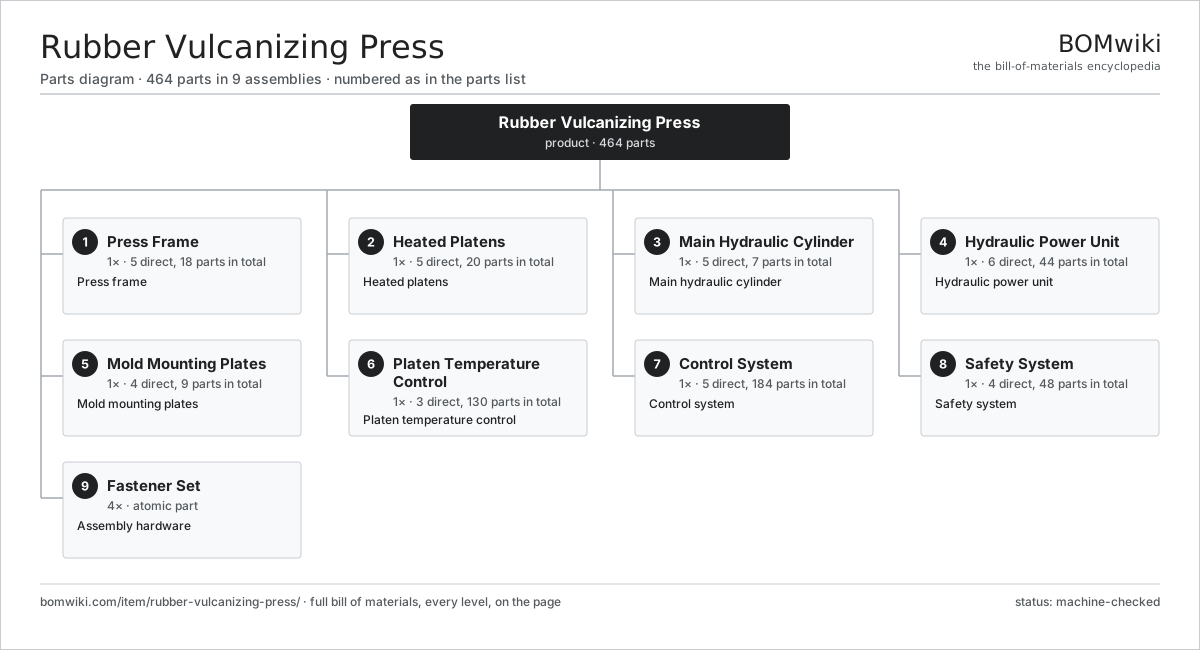
| # | Part | Qty | What it does |
|---|---|---|---|
| 1 | Press Frame 5 parts | 1× | Press frame |
| 2 | Heated Platens 5 parts | 1× | Heated platens |
| 3 | Main Hydraulic Cylinder 5 parts | 1× | Main hydraulic cylinder |
| 4 | Hydraulic Power Unit 6 parts | 1× | Hydraulic power unit |
| 5 | Mold Mounting Plates 4 parts | 1× | Mold mounting plates |
| 6 | Platen Temperature Control 3 parts | 1× | Platen temperature control |
| 7 | Control System 5 parts | 1× | Control system |
| 8 | Safety System 4 parts | 1× | Safety system |
| 9 | Fastener Set | 4× | Assembly hardware |
3D model
No 3D model yet. Have a CAD file of this? Add a 3D model — STL renders right on this page; STEP, FreeCAD, and OpenSCAD sources are welcome too (openly licensed, like all 3D models on BOMwiki).
Build & assembly graph
expand / collapse · shared sub-assemblies converge · links to related products · est. labourTap an assembly to expand/collapse · tap a part to open it · use “Open page” for any node · drag to pan, scroll to zoom.
Bill of materials for Rubber Vulcanizing Press
9 top-level lines · 71 rows shown · 464 parts total · indented to 3 levels| # | Item / sub-assembly | Part no. | Qty/assy | Ext. qty | Parts | Type |
|---|---|---|---|---|---|---|
| 1 | Press Frame 5 parts | rubber-vulcanizing-press-frame | 1× | 1 | 18 | assembly |
| 1.1 | Base Plate | rubber-vulcanizing-press-base-plate | 1× | 1 | · | part |
| 1.2 | Head Plate | rubber-vulcanizing-press-head-plate | 1× | 1 | · | part |
| 1.3 | Tie Bar | rubber-vulcanizing-press-tie-bar | 4× | 4 | · | part |
| 1.4 | Tie-Bar Nut | rubber-vulcanizing-press-tie-nut | 8× | 8 | · | part |
| 1.5 | Column Bushing | rubber-vulcanizing-press-column-bushing | 4× | 4 | · | part |
| 2 | Heated Platens 5 parts | rubber-vulcanizing-press-platens | 1× | 1 | 20 | assembly |
| 2.1 | Top Platen | rubber-vulcanizing-press-top-platen | 1× | 1 | · | part |
| 2.2 | Bottom Platen | rubber-vulcanizing-press-bottom-platen | 1× | 1 | · | part |
| 2.3 | Cartridge Heater 1 parts | rubber-vulcanizing-press-cartridge-heater | 12× | 12 | · | part |
| 2.3.1 | Heating Element | heating-element | 1× | 12 | · | part |
| 2.4 | Platen RTD | rubber-vulcanizing-press-platen-rtd | 4× | 4 | · | part |
| 2.5 | Insulation Board | rubber-vulcanizing-press-insulation-board | 2× | 2 | · | part |
| 3 | Main Hydraulic Cylinder 5 parts | rubber-vulcanizing-press-main-cylinder | 1× | 1 | 7 | assembly |
| 3.1 | Cylinder Body | rubber-vulcanizing-press-cylinder-body | 1× | 1 | · | part |
| 3.2 | Plunger / Ram | rubber-vulcanizing-press-plunger | 1× | 1 | · | part |
| 3.3 | Ram Seal Set 2 parts | rubber-vulcanizing-press-ram-seal | 1× | 1 | · | part |
| 3.3.1 | O-Ring Set | oring-set | 1× | 1 | · | part |
| 3.3.2 | Oil Seal | oil-seal | 1× | 1 | · | part |
| 3.4 | Cylinder Gland | rubber-vulcanizing-press-cylinder-gland | 1× | 1 | · | part |
| 3.5 | Wear Ring | rubber-vulcanizing-press-wear-ring | 2× | 2 | · | part |
| 4 | Hydraulic Power Unit 6 parts | rubber-vulcanizing-press-hpu | 1× | 1 | 44 | assembly |
| 4.1 | Hydraulic Pump 6 parts | rubber-vulcanizing-press-pump | 1× | 1 | 27 | assembly |
| 4.1.1 | Stator Assembly 3 parts + deeper › | stator-assembly | 1× | 1 | 3 | assembly |
| 4.1.2 | Rotor Assembly 4 parts + deeper › | rotor-assembly | 1× | 1 | 19 | assembly |
| 4.1.3 | Pump Housing | rubber-vulcanizing-press-pump-housing | 1× | 1 | · | part |
| 4.1.4 | Ball Bearing | ball-bearing | 2× | 2 | · | part |
| 4.1.5 | Oil Seal | oil-seal | 1× | 1 | · | part |
| 4.1.6 | Pump Element | rubber-vulcanizing-press-pump-element | 1× | 1 | · | part |
| 4.2 | Oil Tank | rubber-vulcanizing-press-oil-tank | 1× | 1 | · | part |
| 4.3 | Valve Block 4 parts | rubber-vulcanizing-press-valve-block | 1× | 1 | 13 | assembly |
| 4.3.1 | Directional Valve | rubber-vulcanizing-press-directional-valve | 2× | 2 | · | part |
| 4.3.2 | Pressure Relief Valve | rubber-vulcanizing-press-relief-valve | 1× | 1 | · | part |
| 4.3.3 | Relay | relay | 4× | 4 | · | part |
| 4.3.4 | O-Ring Set | oring-set | 6× | 6 | · | part |
| 4.4 | Accumulator | rubber-vulcanizing-press-accumulator | 1× | 1 | · | part |
| 4.5 | Oil Filter | rubber-vulcanizing-press-oil-filter | 1× | 1 | · | part |
| 4.6 | System Pressure Transducer 1 parts | rubber-vulcanizing-press-pressure-transducer | 1× | 1 | · | part |
| 4.6.1 | Pressure Sensor | pressure-sensor | 1× | 1 | · | part |
| 5 | Mold Mounting Plates 4 parts | rubber-vulcanizing-press-mold-plates | 1× | 1 | 9 | assembly |
| 5.1 | Bolster Plate | rubber-vulcanizing-press-bolster | 2× | 2 | · | part |
| 5.2 | Mold Clamp | rubber-vulcanizing-press-mold-clamp | 4× | 4 | · | part |
| 5.3 | Locating Ring | rubber-vulcanizing-press-locating-ring | 2× | 2 | · | part |
| 5.4 | Ejector Bar | rubber-vulcanizing-press-ejector-bar | 1× | 1 | · | part |
| 6 | Platen Temperature Control 3 parts | rubber-vulcanizing-press-temp-control | 1× | 1 | 130 | assembly |
| 6.1 | Zone Temperature Controller 2 parts | rubber-vulcanizing-press-temp-controller | 4× | 4 | · | part |
| 6.1.1 | Bare PCB | pcb-bare | 1× | 4 | · | part |
| 6.1.2 | SMD Passive (R/C/L) | smd-passives | 30× | 120 | · | part |
| 6.2 | Solid-State Relay | rubber-vulcanizing-press-ssr | 4× | 4 | · | part |
| 6.3 | Over-Temperature Cutout | rubber-vulcanizing-press-thermal-fuse | 2× | 2 | · | part |
| 7 | Control System 5 parts | rubber-vulcanizing-press-control | 1× | 1 | 184 | assembly |
| 7.1 | PLC 4 parts | rubber-vulcanizing-press-plc | 1× | 1 | 128 | assembly |
| 7.1.1 | Bare PCB | pcb-bare | 1× | 1 | · | part |
| 7.1.2 | Microcontroller | mcu | 1× | 1 | · | part |
| 7.1.3 | Relay | relay | 6× | 6 | · | part |
| 7.1.4 | SMD Passive (R/C/L) | smd-passives | 120× | 120 | · | part |
| 7.2 | HMI Panel 3 parts | rubber-vulcanizing-press-hmi | 1× | 1 | 42 | assembly |
| 7.2.1 | Bare PCB | pcb-bare | 1× | 1 | · | part |
| 7.2.2 | LCD Panel | lcd-panel | 1× | 1 | · | part |
| 7.2.3 | SMD Passive (R/C/L) | smd-passives | 40× | 40 | · | part |
| 7.3 | Power Supply | power-supply | 1× | 1 | · | part |
| 7.4 | Wire Bundle | wire-bundle | 1× | 1 | · | part |
| 7.5 | Connector | connector | 12× | 12 | · | part |
| 8 | Safety System 4 parts | rubber-vulcanizing-press-safety | 1× | 1 | 48 | assembly |
| 8.1 | Light Curtain 2 parts | rubber-vulcanizing-press-light-curtain | 1× | 1 | · | part |
| 8.1.1 | Bare PCB | pcb-bare | 1× | 1 | · | part |
| 8.1.2 | SMD Passive (R/C/L) | smd-passives | 40× | 40 | · | part |
| 8.2 | Limit Switch | rubber-vulcanizing-press-limit-switch | 4× | 4 | · | part |
| 8.3 | Safety Relief Valve | rubber-vulcanizing-press-safety-relief | 1× | 1 | · | part |
| 8.4 | Emergency Stop | rubber-vulcanizing-press-estop | 2× | 2 | · | part |
| 9 | Fastener Set | fastener-set | 4× | 4 | · | part |
Related products
same domain, ranked by shared parts Industrial Parts Washer
423 parts · shares 19 with this page
Industrial Parts Washer
423 parts · shares 19 with this page
 Rubber Extrusion Line
524 parts · shares 19 with this page
Vertical Injection Molding Machine
264 parts · shares 19 with this page
Coil Coating Line
1,767 parts · shares 18 with this page
Powder Coating Line
5,418 parts · shares 18 with this page
Rubber Extrusion Line
524 parts · shares 19 with this page
Vertical Injection Molding Machine
264 parts · shares 19 with this page
Coil Coating Line
1,767 parts · shares 18 with this page
Powder Coating Line
5,418 parts · shares 18 with this page
Sourcing: possible vendors
Prices, MOQ, and lead times are algorithmic estimates, not quotes, and not claims about these companies. Company mappings are curated by keyword; est. price band $5k–$2M. How estimates work| Vendor | HQ | Specialty | MOQ | Lead time |
|---|---|---|---|---|
| atlascopco.com ↗ | Stockholm, SE | Compressors & industrial | 10 units | 12–20 wks |
|
🇦🇹Andritz
andritz.com ↗
|
Graz, AT | Process plants & machinery | 10 units | 12–20 wks |
| buhlergroup.com ↗ | Uzwil, CH | Food & materials processing | 10 units | 12–20 wks |
| gea.com ↗ | Düsseldorf, DE | Process technology | 10 units | 12–20 wks |
| mhi.com ↗ | Tokyo, JP | Heavy machinery | 10 units | 12–20 wks |
928-word article