Vacuum Forming Machine
ProductOverview
A vacuum forming machine shapes a single sheet of plastic by heating it soft and pulling it down onto a mold with vacuum. It is the simplest form of thermoforming and the most common one in workshops, sign shops, model shops, and small production runs, because the molds are cheap and easy to make and the machine itself is straightforward. The process is one cycle at a time: clamp a sheet, slide a heater over it until it softens and sags, lift the mold into it, switch on the vacuum to suck the sheet tight against the mold, let it cool, then release the vacuum and lift out the formed part. From that one idea come things as varied as packaging blisters, machine guards, vehicle panels, props, trays, and prototype housings.
The machine is built on the Machine Frame, holds the sheet in the Clamp Frame, heats it with the Heater Bank, raises the tool on the Mold Table, pulls it down with the Vacuum System system over the Forming Mold, and runs from the Machine Controller.
Frame and clamp
The Machine Frame carries everything in register. A welded Base Frame supports the Worktable, and a pair of Guide Column guides keep the heater and clamp travel parallel, with Levelling Foot feet to level the machine. The sheet is held by the Clamp Frame, a hinged frame whose Clamp Bar bars pin all four edges of the sheet flat. Clamp Hinge hinges let it swing open to load a fresh sheet, Toggle Latch latches lock it shut with even pressure, and a Frame Gasket gasket seals the edge so the vacuum cannot leak past the clamp. A good edge seal is important because any leak weakens the pull and leaves the part loose against the mold.
Heating the sheet
The Heater Bank warms the clamped sheet to forming temperature. It is a bank of ceramic or quartz Heating Element radiant elements held in a Heater Frame with a Reflector Panel panel that aims the heat down at the sheet. The whole bank rides on a Heater Slide so it can be slid over the sheet to heat it and then pulled clear before the mold rises, and a Sheet Pyrometer reads sheet temperature so heating stops at the right moment. Knowing when the sheet is ready is the main skill: the operator watches for a uniform sag, because an under-heated sheet will not draw into detail and an over-heated one webs, thins, or scorches. Larger machines zone the heaters so the cooler edges near the clamp get more heat than the center.
Forming over the mold
When the sheet is ready the Mold Table does the forming. A Lift Cylinder raises the Platen Plate carrying the mold up into the hot sheet, and the Vacuum System system pulls air out of the Vacuum Box under the mold. For deep or detailed parts the operator can first blow a controlled bubble through the Air Port to pre-stretch the sheet so the walls come out more even, which is the simplest form of the plug assist used on bigger lines. The vacuum draws the sheet down onto the Forming Mold, where it copies the Mold Pattern exactly. Trapped air between sheet and mold is the enemy of detail, so the mold carries a Vent Hole Pattern pattern of fine holes that let that air escape, and the Mold Base distributes vacuum across the back of the tool. Male molds give crisp inside detail, female molds give crisp outside detail, and the choice drives how the part is designed.
Vacuum system
The forming force comes from the Vacuum System system. A rotary-vane Vacuum Pump keeps a Vacuum Reservoir tank evacuated, so that when the operator forms a part the stored vacuum pulls the sheet down in a single fast stroke rather than a slow draw that would let the sheet cool before it seats. A Pressure Sensor reads the vacuum level, an Inlet Filter keeps debris out of the pump, and after the part sets a Dump Valve releases the vacuum and admits air to free it. The depth and speed of the pull, set by the reservoir size and pump, are what let the machine form thicker sheet and deeper parts.
Control and use
The Machine Controller runs the sequence. On a manual machine the operator times each step by eye; on a semi-automatic one an Microcontroller runs a programmed heat timer, heater retract, platen lift, vacuum dwell, and release, set from the Operator Panel. A Power Supply feeds the cabinet and a bank of Relay outputs switches the heater, pump, and cylinders through a Wire Bundle of field Connector wiring. Vacuum forming machines suit short runs and large parts where injection molding would be too expensive, and they form the bread-and-butter work of sign shops, prototype shops, and packaging trial runs. Their limits are the flip side of their simplicity: vacuum alone gives less wall-thickness control than the plug-assist and pressure forming used on production lines, so deep parts can come out thin at the corners, and detail is only as good as the vents and the operator's feel for sheet temperature.
Vacuum Forming Machine parts and their functions
7 top-level parts · 73 parts in total · full bill of materials below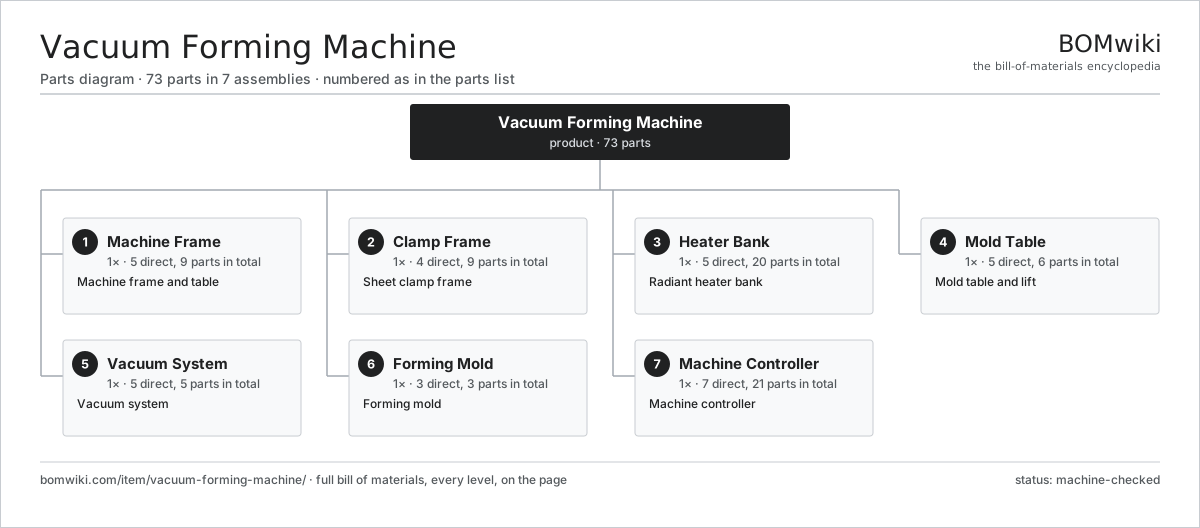
| # | Part | Qty | What it does |
|---|---|---|---|
| 1 | Machine Frame 5 parts | 1× | Machine frame and table |
| 2 | Clamp Frame 4 parts | 1× | Sheet clamp frame |
| 3 | Heater Bank 5 parts | 1× | Radiant heater bank |
| 4 | Mold Table 5 parts | 1× | Mold table and lift |
| 5 | Vacuum System 5 parts | 1× | Vacuum system |
| 6 | Forming Mold 3 parts | 1× | Forming mold |
| 7 | Machine Controller 7 parts | 1× | Machine controller |
3D model
No 3D model yet. Have a CAD file of this? Add a 3D model — STL renders right on this page; STEP, FreeCAD, and OpenSCAD sources are welcome too (openly licensed, like all 3D models on BOMwiki).
Build & assembly graph
expand / collapse · shared sub-assemblies converge · links to related products · est. labourTap an assembly to expand/collapse · tap a part to open it · use “Open page” for any node · drag to pan, scroll to zoom.
Bill of materials for Vacuum Forming Machine
7 top-level lines · 41 rows shown · 73 parts total · indented to 3 levels| # | Item / sub-assembly | Part no. | Qty/assy | Ext. qty | Parts | Type |
|---|---|---|---|---|---|---|
| 1 | Machine Frame 5 parts | vacuum-forming-machine-frame | 1× | 1 | 9 | assembly |
| 1.1 | Base Frame | vacuum-forming-machine-base-frame | 1× | 1 | · | part |
| 1.2 | Worktable | vacuum-forming-machine-worktable | 1× | 1 | · | part |
| 1.3 | Guide Column | vacuum-forming-machine-column | 2× | 2 | · | part |
| 1.4 | Levelling Foot | vacuum-forming-machine-caster | 4× | 4 | · | part |
| 1.5 | Fastener Set | fastener-set | 1× | 1 | · | part |
| 2 | Clamp Frame 4 parts | vacuum-forming-machine-clamp | 1× | 1 | 9 | assembly |
| 2.1 | Clamp Bar | vacuum-forming-machine-clamp-bar | 4× | 4 | · | part |
| 2.2 | Clamp Hinge | vacuum-forming-machine-clamp-hinge | 2× | 2 | · | part |
| 2.3 | Toggle Latch | vacuum-forming-machine-clamp-latch | 2× | 2 | · | part |
| 2.4 | Frame Gasket | vacuum-forming-machine-seal-gasket | 1× | 1 | · | part |
| 3 | Heater Bank 5 parts | vacuum-forming-machine-heater | 1× | 1 | 20 | assembly |
| 3.1 | Heating Element | heating-element | 16× | 16 | · | part |
| 3.2 | Heater Frame | vacuum-forming-machine-heater-frame | 1× | 1 | · | part |
| 3.3 | Reflector Panel | vacuum-forming-machine-heater-reflector | 1× | 1 | · | part |
| 3.4 | Heater Slide | vacuum-forming-machine-heater-slide | 1× | 1 | · | part |
| 3.5 | Sheet Pyrometer | vacuum-forming-machine-pyrometer | 1× | 1 | · | part |
| 4 | Mold Table 5 parts | vacuum-forming-machine-platen | 1× | 1 | 6 | assembly |
| 4.1 | Vacuum Box | vacuum-forming-machine-vacuum-box | 1× | 1 | · | part |
| 4.2 | Lift Cylinder | vacuum-forming-machine-lift-cylinder | 1× | 1 | · | part |
| 4.3 | Platen Plate | vacuum-forming-machine-platen-plate | 1× | 1 | · | part |
| 4.4 | Air Port | vacuum-forming-machine-bubble-port | 1× | 1 | · | part |
| 4.5 | O-Ring Set | oring-set | 2× | 2 | · | part |
| 5 | Vacuum System 5 parts | vacuum-forming-machine-vacuum | 1× | 1 | 5 | assembly |
| 5.1 | Vacuum Pump | vacuum-forming-machine-vacuum-pump | 1× | 1 | · | part |
| 5.2 | Vacuum Reservoir | vacuum-forming-machine-reservoir | 1× | 1 | · | part |
| 5.3 | Dump Valve | vacuum-forming-machine-dump-valve | 1× | 1 | · | part |
| 5.4 | Pressure Sensor | pressure-sensor | 1× | 1 | · | part |
| 5.5 | Inlet Filter | vacuum-forming-machine-filter | 1× | 1 | · | part |
| 6 | Forming Mold 3 parts | vacuum-forming-machine-mold | 1× | 1 | 3 | assembly |
| 6.1 | Mold Pattern | vacuum-forming-machine-mold-pattern | 1× | 1 | · | part |
| 6.2 | Vent Hole Pattern | vacuum-forming-machine-vent-hole | 1× | 1 | · | part |
| 6.3 | Mold Base | vacuum-forming-machine-mold-base | 1× | 1 | · | part |
| 7 | Machine Controller 7 parts | vacuum-forming-machine-control | 1× | 1 | 21 | assembly |
| 7.1 | Bare PCB | pcb-bare | 1× | 1 | · | part |
| 7.2 | Microcontroller | mcu | 1× | 1 | · | part |
| 7.3 | Operator Panel | vacuum-forming-machine-hmi | 1× | 1 | · | part |
| 7.4 | Power Supply | power-supply | 1× | 1 | · | part |
| 7.5 | Relay | relay | 6× | 6 | · | part |
| 7.6 | Connector | connector | 10× | 10 | · | part |
| 7.7 | Wire Bundle | wire-bundle | 1× | 1 | · | part |
Related products
same domain, ranked by shared parts Industrial Parts Washer
423 parts · shares 7 with this page
Industrial Parts Washer
423 parts · shares 7 with this page
 Industrial Ultrasonic Cleaner
787 parts · shares 7 with this page
Micro Injection Molding Machine
704 parts · shares 7 with this page
Industrial Ultrasonic Cleaner
787 parts · shares 7 with this page
Micro Injection Molding Machine
704 parts · shares 7 with this page
Sourcing: possible vendors
Prices, MOQ, and lead times are algorithmic estimates, not quotes, and not claims about these companies. Company mappings are curated by keyword; est. price band $5k–$2M. How estimates work| Vendor | HQ | Specialty | MOQ | Lead time |
|---|---|---|---|---|
| atlascopco.com ↗ | Stockholm, SE | Compressors & industrial | 10 units | 12–20 wks |
|
🇦🇹Andritz
andritz.com ↗
|
Graz, AT | Process plants & machinery | 10 units | 12–20 wks |
| buhlergroup.com ↗ | Uzwil, CH | Food & materials processing | 10 units | 12–20 wks |
| gea.com ↗ | Düsseldorf, DE | Process technology | 10 units | 12–20 wks |
| mhi.com ↗ | Tokyo, JP | Heavy machinery | 10 units | 12–20 wks |
967-word article