Investment Casting Shell Line
ProductOverview
An investment casting shell line builds the ceramic mold used in lost-wax casting. A cluster of wax patterns, assembled onto a central wax sprue to form a tree, is coated with many layers of ceramic until a hard shell encases it. The shell is then heated to melt out the wax, fired to full strength, and filled with molten metal. When the metal has set the shell is broken away, leaving castings that copy the wax exactly. Investment casting reaches finer detail and tighter tolerance than sand casting, which is why it makes turbine blades, surgical implants, fuel-system bodies and intricate art pieces. The shell line is the slow, exacting middle of that process: it lays down coat after coat, each of which must dry under controlled conditions before the next.
The line couples a Dipping Robot that handles the wax tree to a Slurry Station for the wet binder coat and a Stucco Station for the dry grit that anchors it. A Rainfall Sander handles oversized trees, the Drying Room conditions each coat, and a Transfer Conveyor moves trees around the loop. The Control System system holds the coat recipe and the Extraction System system keeps dust and mist out of the air.
The coating cycle
Each coat is two actions followed by a wait. First the Dipping Robot grips the tree by its pour cup and lowers it into the Slurry Tank, where it picks up a film of ceramic slurry. The Rotating Wrist then spins and tilts the tree so excess slurry drains evenly and no pools form in pockets. While the film is still wet, the robot plunges the tree into the Fluidized Bed so coarse refractory grit sticks to it, which gives the coat bulk and a key for the next layer. The coated tree then hangs in the Drying Room for hours until the binder gels and dries. The first one or two prime coats use fine slurry and fine grit to copy the wax surface; the later backup coats use coarser material to build thickness fast. A finished shell is typically six to nine coats.
Slurry control
Shell quality lives or dies on slurry consistency, so the Slurry Station is the most closely watched part of the line. The Slurry Tank holds colloidal silica binder loaded with fine refractory flour, and a slow Slurry Mixer keeps the flour suspended without beating in air bubbles that would leave voids in the shell. A Viscosity Cup tracks viscosity, the single best proxy for how much slurry a tree will pick up, and operators thin or thicken the batch to hold it. A Temperature Jacket keeps the slurry near 22 C because viscosity changes sharply with temperature, and the Recirculation Pump recirculates between tanks so binder and solids stay in proportion across a long shift.
Stucco and backup coats
After each wet dip the tree needs dry grit to lock the coat. Most coats use the Stucco Station, a Fluidized Bed where a Fluidizing Blower pushes air through a porous Air Plenum so the grit behaves like a fluid and the wet tree can be plunged straight into it. Trees too large to immerse instead pass under the Rainfall Sander, where a Sand Curtain Head rains grit over the slowly turning tree and a Bucket Elevator recirculates what falls. Prime coats take fine stucco for surface fidelity; backup coats take coarse grit to build wall thickness quickly so the shell survives dewaxing and pouring.
Drying and conditioning
Drying is as important as coating, because a coat that dries too fast cracks and one that dries too slowly is weak. The Drying Room holds temperature near 22 C and relative humidity in a 40 to 60 percent band, controlled by an Air Handling Unit and a Humidifier working off Humidity Sensor readings. Trees hang on Drying Rack racks in a steady, gentle airflow so the binder gels and the water leaves the coat without shrinkage cracks. Each coat has a prescribed minimum dry time, which is why a full shell can take a day or more to build and why the Transfer Conveyor must track where every tree is in its schedule.
Materials, automation and use
The refractories are chosen for the metal being poured: fused silica and alumino-silicate for general steels, zircon and alumina for the prime coat where reaction with the melt must be avoided, and high-purity alumina for superalloy turbine work. Modern lines run almost untended: the Dipping Robot follows a stored dip recipe of immersion depth, dwell and drain spin for each coat, the Line PLC sequences the stations and logs coat counts, and the Operator HMI lets an operator load a recipe per part family. Because slurry mist and refractory dust are a health and housekeeping concern, every station sits under a Capture Hood feeding the Dust Collector. Small jobbing shops still dip by hand and dry on open racks, but production foundries for aerospace and medical work run fully robotic lines like this one to keep coat-to-coat variation small.
Investment Casting Shell Line parts and their functions
8 top-level parts · 869 parts in total · full bill of materials below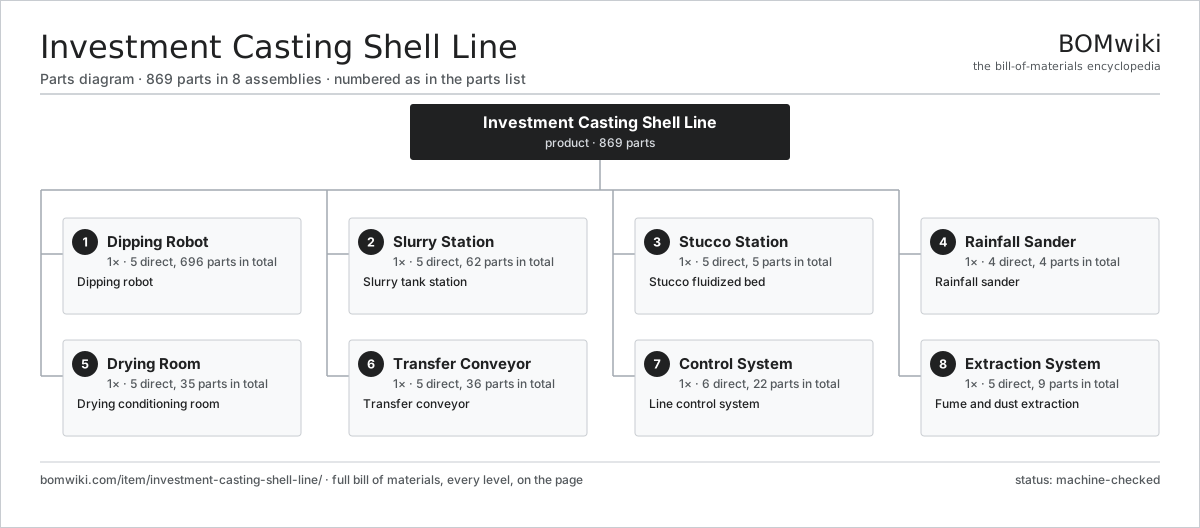
| # | Part | Qty | What it does |
|---|---|---|---|
| 1 | Dipping Robot 5 parts | 1× | Dipping robot |
| 2 | Slurry Station 5 parts | 1× | Slurry tank station |
| 3 | Stucco Station 5 parts | 1× | Stucco fluidized bed |
| 4 | Rainfall Sander 4 parts | 1× | Rainfall sander |
| 5 | Drying Room 5 parts | 1× | Drying conditioning room |
| 6 | Transfer Conveyor 5 parts | 1× | Transfer conveyor |
| 7 | Control System 6 parts | 1× | Line control system |
| 8 | Extraction System 5 parts | 1× | Fume and dust extraction |
3D model
No 3D model yet. Have a CAD file of this? Add a 3D model — STL renders right on this page; STEP, FreeCAD, and OpenSCAD sources are welcome too (openly licensed, like all 3D models on BOMwiki).
Build & assembly graph
expand / collapse · shared sub-assemblies converge · links to related products · est. labourTap an assembly to expand/collapse · tap a part to open it · use “Open page” for any node · drag to pan, scroll to zoom.
Bill of materials for Investment Casting Shell Line
8 top-level lines · 73 rows shown · 869 parts total · indented to 3 levels| # | Item / sub-assembly | Part no. | Qty/assy | Ext. qty | Parts | Type |
|---|---|---|---|---|---|---|
| 1 | Dipping Robot 5 parts | investment-casting-shell-line-robot | 1× | 1 | 696 | assembly |
| 1.1 | Robot Arm | investment-casting-shell-line-robot-arm | 1× | 1 | · | part |
| 1.2 | Rotating Wrist | investment-casting-shell-line-wrist | 1× | 1 | · | part |
| 1.3 | Tree Gripper | investment-casting-shell-line-gripper | 1× | 1 | · | part |
| 1.4 | Servo Motor 4 parts | servo-motor | 6× | 6 | 24 | assembly |
| 1.4.1 | Stator Assembly 3 parts + deeper › | stator-assembly | 1× | 6 | 3 | assembly |
| 1.4.2 | Rotor Assembly 4 parts + deeper › | rotor-assembly | 1× | 6 | 19 | assembly |
| 1.4.3 | Encoder | encoder | 1× | 6 | · | part |
| 1.4.4 | Motor Housing | motor-housing | 1× | 6 | · | part |
| 1.5 | Robot Controller 4 parts | investment-casting-shell-line-robot-controller | 1× | 1 | 549 | assembly |
| 1.5.1 | Bare PCB | pcb-bare | 1× | 1 | · | part |
| 1.5.2 | Microcontroller | mcu | 1× | 1 | · | part |
| 1.5.3 | Servo Drive 4 parts + deeper › | servo-drive | 6× | 6 | 91 | assembly |
| 1.5.4 | Power Supply | power-supply | 1× | 1 | · | part |
| 2 | Slurry Station 5 parts | investment-casting-shell-line-slurry-station | 1× | 1 | 62 | assembly |
| 2.1 | Slurry Tank | investment-casting-shell-line-slurry-tank | 2× | 2 | · | part |
| 2.2 | Slurry Mixer 4 parts | investment-casting-shell-line-slurry-mixer | 2× | 2 | 28 | assembly |
| 2.2.1 | Mixer Impeller | investment-casting-shell-line-mixer-impeller | 1× | 2 | · | part |
| 2.2.2 | Servo Motor 4 parts + deeper › | servo-motor | 1× | 2 | 24 | assembly |
| 2.2.3 | Helical Gear Pair | gear-pair | 1× | 2 | · | part |
| 2.2.4 | Ball Bearing | ball-bearing | 2× | 4 | · | part |
| 2.3 | Viscosity Cup | investment-casting-shell-line-viscometer | 1× | 1 | · | part |
| 2.4 | Temperature Jacket | investment-casting-shell-line-temp-jacket | 2× | 2 | · | part |
| 2.5 | Recirculation Pump | investment-casting-shell-line-slurry-pump | 1× | 1 | · | part |
| 3 | Stucco Station 5 parts | investment-casting-shell-line-stucco-station | 1× | 1 | 5 | assembly |
| 3.1 | Fluidized Bed | investment-casting-shell-line-fluid-bed | 1× | 1 | · | part |
| 3.2 | Air Plenum | investment-casting-shell-line-air-plenum | 1× | 1 | · | part |
| 3.3 | Fluidizing Blower | investment-casting-shell-line-bed-blower | 1× | 1 | · | part |
| 3.4 | Grit Feeder | investment-casting-shell-line-grit-feeder | 1× | 1 | · | part |
| 3.5 | Pressure Sensor | pressure-sensor | 1× | 1 | · | part |
| 4 | Rainfall Sander 4 parts | investment-casting-shell-line-rainfall-sander | 1× | 1 | 4 | assembly |
| 4.1 | Sand Curtain Head | investment-casting-shell-line-sand-curtain | 1× | 1 | · | part |
| 4.2 | Bucket Elevator | investment-casting-shell-line-sand-elevator | 1× | 1 | · | part |
| 4.3 | Recovery Screen | investment-casting-shell-line-sand-screen | 1× | 1 | · | part |
| 4.4 | Drive Belt | drive-belt | 1× | 1 | · | part |
| 5 | Drying Room 5 parts | investment-casting-shell-line-dry-room | 1× | 1 | 35 | assembly |
| 5.1 | Drying Rack | investment-casting-shell-line-dry-rack | 4× | 4 | · | part |
| 5.2 | Air Handling Unit 3 parts | investment-casting-shell-line-ahu | 1× | 1 | 27 | assembly |
| 5.2.1 | Supply Fan | investment-casting-shell-line-ahu-fan | 1× | 1 | · | part |
| 5.2.2 | Air Filter | investment-casting-shell-line-ahu-filter | 2× | 2 | · | part |
| 5.2.3 | Servo Motor 4 parts + deeper › | servo-motor | 1× | 1 | 24 | assembly |
| 5.3 | Humidifier | investment-casting-shell-line-humidifier | 1× | 1 | · | part |
| 5.4 | Humidity Sensor | investment-casting-shell-line-rh-sensor | 2× | 2 | · | part |
| 5.5 | Heating Element | heating-element | 1× | 1 | · | part |
| 6 | Transfer Conveyor 5 parts | investment-casting-shell-line-conveyor | 1× | 1 | 36 | assembly |
| 6.1 | Overhead Track | investment-casting-shell-line-track-rail | 1× | 1 | · | part |
| 6.2 | Tree Trolley | investment-casting-shell-line-trolley | 8× | 8 | · | part |
| 6.3 | Chain Drive | investment-casting-shell-line-chain-drive | 1× | 1 | · | part |
| 6.4 | Servo Motor 4 parts | servo-motor | 1× | 1 | 24 | assembly |
| 6.4.1 | Stator Assembly 3 parts + deeper › | stator-assembly | 1× | 1 | 3 | assembly |
| 6.4.2 | Rotor Assembly 4 parts + deeper › | rotor-assembly | 1× | 1 | 19 | assembly |
| 6.4.3 | Encoder | encoder | 1× | 1 | · | part |
| 6.4.4 | Motor Housing | motor-housing | 1× | 1 | · | part |
| 6.5 | Linear Guide Rail | linear-guide | 2× | 2 | · | part |
| 7 | Control System 6 parts | investment-casting-shell-line-control | 1× | 1 | 22 | assembly |
| 7.1 | Line PLC 3 parts | investment-casting-shell-line-plc | 1× | 1 | 3 | assembly |
| 7.1.1 | Bare PCB | pcb-bare | 1× | 1 | · | part |
| 7.1.2 | Microcontroller | mcu | 1× | 1 | · | part |
| 7.1.3 | SMD Passive (R/C/L) | smd-passives | 1× | 1 | · | part |
| 7.2 | Operator HMI 3 parts | investment-casting-shell-line-hmi | 1× | 1 | 3 | assembly |
| 7.2.1 | LCD Panel | lcd-panel | 1× | 1 | · | part |
| 7.2.2 | Microcontroller | mcu | 1× | 1 | · | part |
| 7.2.3 | Bare PCB | pcb-bare | 1× | 1 | · | part |
| 7.3 | Power Supply | power-supply | 1× | 1 | · | part |
| 7.4 | Wire Bundle | wire-bundle | 1× | 1 | · | part |
| 7.5 | Connector | connector | 8× | 8 | · | part |
| 7.6 | Relay | relay | 6× | 6 | · | part |
| 8 | Extraction System 5 parts | investment-casting-shell-line-extraction | 1× | 1 | 9 | assembly |
| 8.1 | Capture Hood | investment-casting-shell-line-dust-hood | 4× | 4 | · | part |
| 8.2 | Ductwork | investment-casting-shell-line-ducting | 1× | 1 | · | part |
| 8.3 | Dust Collector | investment-casting-shell-line-collector | 1× | 1 | · | part |
| 8.4 | Extraction Fan | investment-casting-shell-line-extract-fan | 1× | 1 | · | part |
| 8.5 | Sheet Metal Panel | sheet-panel | 2× | 2 | · | part |
Related products
same domain, ranked by shared parts Injection Molding Machine
292 parts · shares 24 with this page
Injection Molding Machine
292 parts · shares 24 with this page
 Continuous Galvanizing Line
1,296 parts · shares 24 with this page
Acid Pickling Line
1,163 parts · shares 23 with this page
Continuous Galvanizing Line
1,296 parts · shares 24 with this page
Acid Pickling Line
1,163 parts · shares 23 with this page
 Dynamic Balancing Machine
573 parts · shares 20 with this page
Coil Coating Line
1,767 parts · shares 23 with this page
Dynamic Balancing Machine
573 parts · shares 20 with this page
Coil Coating Line
1,767 parts · shares 23 with this page
Sourcing: possible vendors
Prices, MOQ, and lead times are algorithmic estimates, not quotes, and not claims about these companies. Company mappings are curated by keyword; est. price band $5k–$2M. How estimates work| Vendor | HQ | Specialty | MOQ | Lead time |
|---|---|---|---|---|
| atlascopco.com ↗ | Stockholm, SE | Compressors & industrial | 10 units | 12–20 wks |
|
🇦🇹Andritz
andritz.com ↗
|
Graz, AT | Process plants & machinery | 10 units | 12–20 wks |
| buhlergroup.com ↗ | Uzwil, CH | Food & materials processing | 10 units | 12–20 wks |
| gea.com ↗ | Düsseldorf, DE | Process technology | 10 units | 12–20 wks |
| mhi.com ↗ | Tokyo, JP | Heavy machinery | 10 units | 12–20 wks |
978-word article